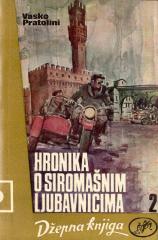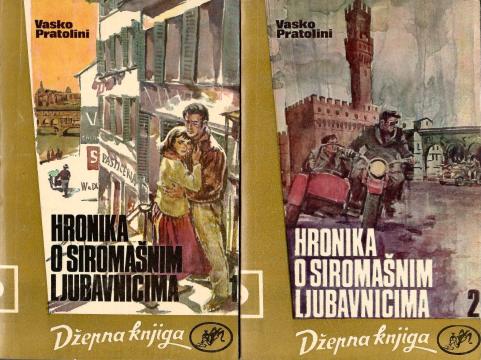
Hronika o siromašnim ljubavnicima

Hronika o siromašnim ljubavnicima

Vasco Pratolini

In Florence 1925–1926, in the poor Via del Corno, the residents live in love, poverty and fear. The arrival of fascism destroys the community: lovers fight, some die from violence, but popular solidarity survives.

“Chronicle of the Poor Lovers” (1947) by Vasco Pratolini is a classic neorealist work of Italian post-war literature. The novel is a choral depiction of life in the Florentine via del Corno – a narrow, poor street near the city center – between 1925 and 1926, during the rise and consolidation of the fascist regime.

The story revolves around the residents of the street (the so-called “cornacchiai”): workers, artisans, small merchants and their families. The main characters are young couples like Mario and Milena (pure, idealistic love), the sensual relationships of Aurora and the coal miner Nesio, and others – Bianca, Clara, Maciste, Ugo. Life is marked by poverty, interconnectedness (everyone knows everything about everyone), loves, quarrels and fear.

Pratolini subtly weaves in the historical context: the rise of fascism brings violence (manganelli, squadristi), blackmail, fear and division. Characters like the fascists Carlin and Osvaldo, the “Signore” (a former courtesan who controls property and collaborates with the regime) or anti-fascists like Maciste illustrate the conflict. The violence culminates in the death of some characters (e.g. Maciste killed by the fascists), the suffering of women and the destruction of balance.

The novel uses the technique of “chronicle” in the historical present, which gives a sense of eternity and immediacy. Without pathos, realistic and lyrical, it depicts the solidarity of the poor, resistance to fascism from below and love as a refuge in darkness. One of the most important works of neorealism, translated into Serbian/Croatian as “Chronicle of Poor Lovers” (e.g. Liber, Zagreb 1982), filmed in 1954 (dir. Carlo Lizzani).

Naslov originala
Cronache di poveri amanti
Prevod
Branka Rakić
Urednik
Risto Trifković
Naslovnica
Mirko Stojnić
Dimenzije
16,5 x 11 cm
Ukupan broj strana
460
Izdavač
Svjetlost, Sarajevo, 1966.
 
Latinica. Broširano.
Jezik: Srpski.

Knjiga se sastoji od dva toma.

Jedan višetomni primerak je u ponudi.
Dodato u korpu!

Hronika o siromašnim ljubavnicima
Prvi tom
Broj strana: 227
Stanje:Nekorišćeno
Hronika o siromašnim ljubavnicima
Drugi tom
Broj strana: 233
Stanje:Nekorišćeno
 

Zanima Vas i neka druga knjiga? Možete pretražiti našu ponudu pomoću pretrage ili prelistati knjige po kategorijama.

Možda će Vas zanimati i ovi naslovi

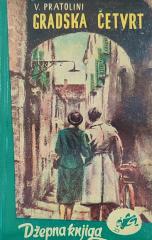
Gradska četvrt

Gradska četvrt

Vasco Pratolini

In Florence, 1932–1939, in the poor neighborhood of Santa Croce, a group of young men go through first loves, fights, friendships, and maturation. Fascism is spreading, but they experience moments of joy and longing in street life, forming an awareness of

Džepna knjiga, 1956.
Srpski. Latinica. Broširano.
2,48
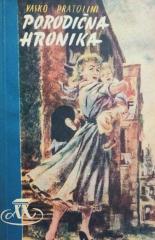
Porodična hronika

Porodična hronika

Vasco Pratolini

Radnja knjige “Porodična hronika” autora Vaska Pratolinija smještena je u Firencu, Italija, i prati život obitelji Martini u razdoblju između dva svetska rata.

Džepna knjiga, 1956.
Hrvatski. Latinica. Broširano.
2,76
Zmijsko leglo

Zmijsko leglo

Andrea Camilleri

Zmijsko leglo (2008.) dio je serijala o inspektoru Salvu Montalbanu. Smješten u izmišljeni sicilijanski grad Vigàtu, roman spaja kriminalističku napetost, psihološku dubinu i Camillerijev prepoznatljivi humor, uz kritiku društvenih problema Sicilije.

Profil Knjiga, 2014.
Hrvatski. Latinica. Broširano.
8,36
Pismo nerođenom djetetu

Pismo nerođenom djetetu

Oriana Fallaci

Jedno od najpotresnijih i najhrabrijih djela svjetske književnosti 20. stoljeća. Napisano kao dugi monolog trudne žene (same Fallaci), knjiga je istovremeno intimna ispovijest, feministički manifest i filozofsko suočavanje sa smislom života i majčinstva.

Znanje, 2009.
Hrvatski. Latinica. Broširano.
4,56
U sjeni bregova

U sjeni bregova

Paola Drigo

The novel depicts the tragic fate of Mariuta (Marije Zef) and her younger sister Rosuta. The work shocked contemporaries with its boldness in depicting taboo subjects, and is today considered a classic portrait of female suffering in rural Italy.

Matica hrvatska, 1961.
Hrvatski. Latinica. Tvrde korice s omotom.
5,32
Pismo nerođenu djetetu: Svjedočanstvo pobunjene žene

Pismo nerođenu djetetu: Svjedočanstvo pobunjene žene

Oriana Fallaci

The touching and painfully honest dialogue of a mother with her unborn child, written by the famous Italian journalist and writer Oriana Fallaci, has been delighting generations of readers around the world for decades.

Znanje, 1980.
Hrvatski. Latinica. Broširano.
4,26