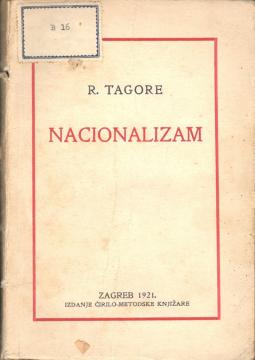
Nacionalizam
Rabindranath Tagore examines nationalism, the relationship between state and society, and the dangers of political power. A major work of humanist political thought, published in Zagreb in 1921.
In Nationalism, Indian poet, philosopher and Nobel Prize laureate Rabindranath Tagore (1861–1941) offers a penetrating critique of one of the defining political forces of the modern age. Drawing on colonial India's experience and the rise of modern nation-states, he warns against reducing human communities to instruments of political and economic power.
Based on lectures delivered in 1916 and 1917, the original English edition of Nationalism (1917) explores nationalism in the West, Japan and India. Tagore distinguishes the organic life of a society from the machinery of the modern nation-state, challenging imperialism, economic competition and claims of national superiority.
His argument does not reject cultural identity or affection for one's homeland. Rather, it defends individual freedom, moral responsibility and mutual understanding against collective selfishness and political exclusion.
Published in Zagreb in 1921, just a few years after the English original and in the aftermath of the First World War, this edition brought Tagore's reflections to readers at a time when Europe's borders and national identities were being radically reshaped.
The work remains an important contribution to political philosophy, anti-colonial thought and modern humanism, inviting readers to reconsider the relationship between national identity and universal human values.
Jedan primerak je u ponudi
- Library stamp