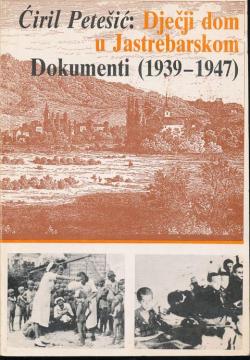
Dječji dom u Jastrebarskom: Dokumenti (1939-1947.)

Dječji dom u Jastrebarskom: Dokumenti (1939-1947.)

Ćiril Petešić

The book focuses on the period when a children's camp existed in Jastrebarsko for children brought from the Stara Gradiška camp and other Jasenovac camps, from July 12th to the beginning of November 1942.

The reason for this is that a large number of articles, feuilletons, and several books were devoted to this period in our post-war press, but no critical account of the events was given. Another reason is that the most important documents were not published in their entirety. Some of them, if they were quoted, were used for the purpose of a particular discussion or book, but not those parts of the documents that give things a noticeably different light. The third reason is that numerous "memories" were published, created 30-40 years after the events in Jastrebarski during the Second World War. "Memories" were published mostly in fragments, and they are nevertheless second-rate (secondary) documents. For these reasons, I tried to pay as much attention as possible to the publication of the primary documents in their entirety, and in this respect, in my opinion, the value of this book lies. Until now, readers have not had the opportunity to notice that the short history of the children's home in Jastrebarski had several phases: pre-war, when Banovina Hrvatska founded its home for orphans, initial wartime, until the camp for children from the Jasenovac camps was added to the children's home, which existed for almost 4 months, a further phase until the end of the war and a post-war phase. The establishment of a children's infectious disease hospital was particularly significant, which continued to operate as an epidemic hospital after the end of the children's camp. In addition, there were actually three children's homes in Jastrebarski, and they were state children's homes, under the care and supervision of the Banovina Hrvatska, the Ministry of the NDH and after the war the Republic of Croatia.

Naslovnica
Martina Petek Stupar
Dimenzije
24 x 17 cm
Broj strana
212
Izdavač
Kršćanska sadašnjost, Zagreb, 1990.
 
Tiraž: 1.200 primeraka
 
Latinica. Broširano.
Jezik: Hrvatski.
ISBN
8-63-970084-2

Nema primeraka u ponudi

Poslednji primerak je nedavno prodat.
 

Zanima Vas i neka druga knjiga? Možete pretražiti našu ponudu pomoću pretrage ili prelistati knjige po kategorijama.

Možda će Vas zanimati i ovi naslovi

Istočna Hrvatska: Osijek – Vukovar – Ilok (zbornik radova)

Istočna Hrvatska: Osijek – Vukovar – Ilok (zbornik radova)

The collection contains papers from the international scientific conference, Eastern Croatia: Osijek – Vukovar – Ilok, held in 1999.

Pedagoški fakultet, 2002.
Hrvatski. Latinica. Broširano.
7,98
Izabrani radovi

Izabrani radovi

Ljubo Boban

Selected Works of Academician Ljubo Boban (2022) brings together key texts on contemporary Croatian history of the 20th century. The foreword by Damir Agičić highlights Boban's methodological rigor and objectivity in researching sensitive topics.

Srednja Europa, 2022.
Hrvatski. Latinica. Tvrde korice.
24,52
Zaraćeno poraće: Konfliktni i konkurentski narativi o stradanju i iseljavanju Talijana Istre

Zaraćeno poraće: Konfliktni i konkurentski narativi o stradanju i iseljavanju Talijana Istre

Franko Dota

The book analyzes how conflicting historical narratives about the suffering and mass emigration of Italians from Istria and Rijeka developed in Croatia and Italy after World War II (1943–1956), debunking myths and encouraging an empathetic approach to the

Srednja Europa, 2010.
Hrvatski. Latinica. Broširano.
11,32
Komunizam i čovjek: Odnos vlasti i pojedinca u Hrvatskoj (1958.–1972.)

Komunizam i čovjek: Odnos vlasti i pojedinca u Hrvatskoj (1958.–1972.)

Josip Mihaljević

Josip Mihaljević's book analyzes the relationship between the government and the individual in communist Croatia (1958–1972), through repressive mechanisms, ideological pressures, and restrictions on personal freedom in the socialist system.

Hrvatski institut za povijest, 2016.
Hrvatski. Latinica. Tvrde korice.
17,26
Osječka groblja

Osječka groblja

Stjepan Sršan

The book is deeply rooted in the local history and culture of Osijek, with an emphasis on cemetery motifs that serve as a metaphor for memory, death, and disappearance.

Povijesni arhiv u Osijeku, 1996.
Hrvatski. Latinica. Broširano.
5,263,95
Povijest i kultura Hrvata kroz 1000 godina: Od velikih seoba do XVIII. stoljeća

Povijest i kultura Hrvata kroz 1000 godina: Od velikih seoba do XVIII. stoljeća

Horvat
Josip Horvat

One of the most prominent Croatian cultural historians, Josip Horvat, in one of his best texts, not only describes the cultural achievements of Croats, but also analyzes them on the basis of political, social and other events that Croatian history is full

Knjigotisak d. o. o., 2009.
Hrvatski. Latinica. Tvrde korice.
12,209,15