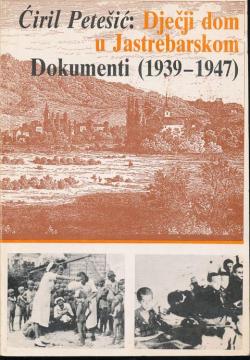
Dječji dom u Jastrebarskom: Dokumenti (1939-1947.)

Dječji dom u Jastrebarskom: Dokumenti (1939-1947.)

Ćiril Petešić

The book focuses on the period when a children's camp existed in Jastrebarsko for children brought from the Stara Gradiška camp and other Jasenovac camps, from July 12th to the beginning of November 1942.

The reason for this is that a large number of articles, feuilletons, and several books were devoted to this period in our post-war press, but no critical account of the events was given. Another reason is that the most important documents were not published in their entirety. Some of them, if they were quoted, were used for the purpose of a particular discussion or book, but not those parts of the documents that give things a noticeably different light. The third reason is that numerous "memories" were published, created 30-40 years after the events in Jastrebarski during the Second World War. "Memories" were published mostly in fragments, and they are nevertheless second-rate (secondary) documents. For these reasons, I tried to pay as much attention as possible to the publication of the primary documents in their entirety, and in this respect, in my opinion, the value of this book lies. Until now, readers have not had the opportunity to notice that the short history of the children's home in Jastrebarski had several phases: pre-war, when Banovina Hrvatska founded its home for orphans, initial wartime, until the camp for children from the Jasenovac camps was added to the children's home, which existed for almost 4 months, a further phase until the end of the war and a post-war phase. The establishment of a children's infectious disease hospital was particularly significant, which continued to operate as an epidemic hospital after the end of the children's camp. In addition, there were actually three children's homes in Jastrebarski, and they were state children's homes, under the care and supervision of the Banovina Hrvatska, the Ministry of the NDH and after the war the Republic of Croatia.

Naslovnica
Martina Petek Stupar
Dimenzije
24 x 17 cm
Broj strana
212
Nakladnik
Kršćanska sadašnjost, Zagreb, 1990.
 
Tiraž: 1.200 primjeraka
 
Latinica. Broširano.
Jezik: Hrvatski.
ISBN
8-63-970084-2

Nema primjeraka u ponudi

Poslednji primjerak je nedavno prodan.
 

Zanima Vas i neka druga knjiga? Možete pretražiti našu ponudu pomoću tražilice ili prelistati knjige po kategorijama.

Možda će Vas zanimati i ovi naslovi

Metamorfoze Ruskog Carstva 1721. - 1921.: Geopolitika, ode i narodi

Metamorfoze Ruskog Carstva 1721. - 1921.: Geopolitika, ode i narodi

Andrzej Nowak

A historical study of the transformations of the Russian Empire from Peter the Great to the early USSR, focusing on imperial geopolitics, ideological patterns, and relations with peoples within the empire.

Fortuna d.o.o., 2023.
Hrvatski. Latinica. Tvrde korice.
35,00
Hitler osvajač: raskrinkavanje jedne legende

Hitler osvajač: raskrinkavanje jedne legende

Rudolf Olden

One of the first anti-Hitler works, published by Nolit as early as 1933. This is an early, shorter version of the work (originally published anonymously in Prague), which preceded the expanded edition from Amsterdam in 1935.

Nolit, 1933.
Hrvatski. Latinica. Tvrde korice s ovitkom.
15,32
Božja zemlja Nippon: Poučno o Japanu

Božja zemlja Nippon: Poučno o Japanu

Friedrich K. Haider, Slavko Pavičić

"God's Land Nippon" by Friedrich K. Haider and Slavko Pavičić is an educational book about Japan, its culture, history, customs and spirituality during World War II. Popular propaganda reading for the NDH.

Nakladna knjižara Velebit, 1942.
Hrvatski. Latinica. Broširano.
14,72
Povratak iz Gulaga: Tajni referat Hruščova

Povratak iz Gulaga: Tajni referat Hruščova

Karlo Štajner

A sequel to his memoir 7000 Days in Siberia, in which he describes his twenty-year imprisonment in Soviet gulags. The book delves into his experiences in the camps, providing additional insights into Steiner's life and reflections on communist ideals.

Globus, 1986.
Hrvatski. Latinica. Tvrde korice s ovitkom.
10,76 - 11,24
Ljudi-miševi

Ljudi-miševi

Manuel Leguineche, Jesus Torbado

The book "Mice People" by Manuel Leguineche and Jesús Torbad is an extremely powerful testimony about human destinies during and after the Spanish Civil War (1936-1939).

Alfa, 1979.
Hrvatski. Latinica. Tvrde korice s ovitkom.
6,32
Mein Kampf / Moja borba

Mein Kampf / Moja borba

Adolf Hitler

Hitler's book combines autobiography and political manifesto, laying the foundations of Nazi ideology. The work has been banned in many countries for promoting hatred, but it remains a historical document that reveals the origins of Nazi crimes.

Kvrga izdavaštvo, 1999.
Hrvatski. Latinica. Tvrde korice.
27,00