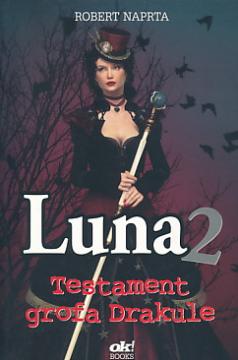
In the first sequel to Luna, the author Robert Naprta introduced us to the main character Luna, a girl with unusual tendencies and talents.
After losing her parents, Luna moves to Zagreb with her aunt Vanessa, where she learns that she is a witch. She suddenly found herself at the center of the conflict between vampires and werewolves, giving her heart to the person who should be her enemy - the vampire Alex...
Editor
Neven Kepeski
Illustrationen
Fotolia
Titelseite
Tatjana Bukovec
Maße
19 x 13 cm
Seitenzahl
160
Verlag
EPH media d. o. o., Zagreb, 2012.
Latein Schrift. Taschenbuch.
Sprache: Kroatisch.
ISBN
978-9-53572-281-6
Angeboten wird ein Exemplar
Zustand:Gebraucht, in ausgezeichnetem Zustand
Reduzierter Preis: 4,983,98 €
Der Rabatt von 20 % gilt bis zum 10.01.2026 23:59 Uhr
Interessieren Sie sich für ein anderes Buch? Sie können das Angebot über unsere Suchmaschine suchen und finden oder Bücher nach Kategorien durchsuchen.
Mikhail Pukhov, Tom Godwin, Henry Slesar, Gerald Kersh, Damir Bajs, Arthur C. Clarke, Borivoje To...
Sirius was a Croatian science fiction magazine. The foundation was proposed by Damir Mikuličić in 1976. In Sirius, the works of domestic authors, as well as translations of foreign SF authors, were published. It was published from 1976 to 1989.
A. E. Van Vogt, Gradimir J. Moskovljević, Diana Nemanja, H. B. Fyfe, Ray Bradbury, Murray Leinste...
Sirius was a Croatian science fiction magazine. The foundation was proposed by Damir Mikuličić in 1976. In Sirius, the works of domestic authors were published, as well as translations of foreign SF authors. It was published from 1976 to 1989.
Gordon Eklund, Denis Ivković, Neven Jovanović, Stjepan Lubina, Gordan Momčilović, Dragan Nedeljko...
Sirius was a Croatian science fiction magazine. The foundation was proposed by Damir Mikuličić in 1976. In Sirius, the works of domestic authors, as well as translations of foreign SF authors, were published. It was published from 1976 to 1989.
The novel Nevolje sa Tiho was originally published in 1961 and in a sense marks the end of the first phase of Simak's creativity - namely, the one dominated by the "space opera" tradition.