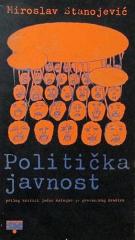
Kritika srpskog uma

Kritika srpskog uma

Novica Milić

The book's starting point is that the Serbs were not only caught up in the Enlightenment later than its European foray in the 18th century, but they resisted it even when it caught up with them. In the Balkans, history followed different paths, had differ

On the one hand, Milić analyzes the motives of Kant's criticism, showing that "criticism" in Kant means "justification", that is, under what conditions reason and mind are legitimately used. Illegitimate, for example, is the use of the mind that does not know its own limits, as in the Holocaust, for example, where the Nazis tried to justify the extermination of the Jews with (false) rational arguments. Where, therefore, the mind is unable to recognize and set limits for itself, to establish itself, where the mind does not recognize the laws (constitutions) that it has established for the benefit of the entire community, disaster inevitably follows. On the other hand, analyzing the history of Serbia, Milić shows what was happening in Serbia at a time when, in Europe, spears were breaking for the rule of reason (law), that is, when the ideas of enlightenment, despite all obstacles, stabilized. Milić's analysis of history, however, does not go in large waves, but focuses on important bearers of modern ideas (like Dositej Obradović or Božo Grujović), that is, on the fiercest opponents of modernization projects (like Nikolaj Velimirović), in order to show, in small steps, why Serbia never accepted the ideas of the Enlightenment, why it fell off the European track and remained on secondary historical paths. In other words, Serbia has never in its history been able to adopt criticism - in every sense of the term - nor to institutionalize it as a necessary prerequisite for a healthy common life.

Maße
19 x 12 cm
Seitenzahl
206
Verlag
Most art Jugoslavija, Beograd, 2023.
 
Kyrillisch Schrift. Taschenbuch.
Sprache: Serbisch.

Angeboten wird ein Exemplar

Zustand:Gebraucht, in ausgezeichnetem Zustand
Zum Warenkorb hinzugefügt!
 

Interessieren Sie sich für ein anderes Buch? Sie können das Angebot über unsere Suchmaschine suchen und finden oder Bücher nach Kategorien durchsuchen.

Diese Titel könnten Sie auch interessieren

Haosmos Basara

Haosmos Basara

Novica Milić

Novica Milić daje Basari status kakav zaslužuje - čita ga kao relevantnog svjetskog pisca. On ga "izvlači" iz kaljuže palanke i postavlja na pozornicu svjetske književnosti, gdje je bitno samo jedno: što i kako pisac radi s riječima.

Factum izdavaštvo, 2020.
Serbisch. Kyrillisch Schrift. Taschenbuch.
9,56
Pjesnik govori: filozofsko-estetske kozerije

Pjesnik govori: filozofsko-estetske kozerije

Drago Ćepulić

"Pjesnik govori: filozofsko-estetske kozerije" Dragutina (Drage) Ćepulića zbirka je kratkih, misaonih eseja u kojima autor na duhovit, pronicljiv i nenametljiv način promišlja o književnosti, umjetnosti, filozofiji i čovjekovu stvaralaštvu.

Minerva nakladna knjižara, 1943.
Kroatisch. Latein Schrift. Taschenbuch.
6,24
Die Frage nach dem Ding

Die Frage nach dem Ding

Martin Heidegger

Pitanje o stvari zbirka predavanja koje je Heidegger održao 1935./36., bavi se temeljnim filozofskim pitanjem: Što je stvar?. Polazište mu je Kantova Kritika čistog uma, ali Heidegger ide dalje, želeći razjasniti samu prirodu stvari iz perspektive Bitka.

Max Niemeyer Verlag, 1975.
Deutsch. Latein Schrift. Fester Einband mit Schutzumschlag.
24,99
O realizmu bez obala

O realizmu bez obala

Roger Garaudy

Predgovor knjizi napisao Louis Aragon.

Mladost, 1968.
Kroatisch. Latein Schrift. Taschenbuch.
5,48
Stiegler and Technics

Stiegler and Technics

Christina Howells, Gerald Moore, Christopher Johnson, Michael Lewis, Ian James, Serge Trottein, P...

Ova zbirka eseja prva je knjiga na engleskom jeziku o djelu Bernarda Stieglera, sve značajnije ličnosti u novoj generaciji francuskih filozofa koja se, tijekom posljednjih desetak godina, pojavila nakon Foucaulta, Deleuzea i Derridaa.

Edinburgh University Press, 2013.
Englisch. Latein Schrift. Taschenbuch.
13,24
Zamke pristojnosti: Eseji o feminizmu i popularnoj kulturi

Zamke pristojnosti: Eseji o feminizmu i popularnoj kulturi

Maša Grdešić

Zamke pristojnosti nadahnut su spoj erudicije i topline, feminističke ljutnje i ranjivosti. Čitajući knjigu osjećamo da nas kroz izazove kapitalističke i patrijarhalne svakodnevice vodi sigurna ruka, koja ispisuje knjigu kojoj je stalo do nas.

Fraktura, 2020.
Kroatisch. Latein Schrift. Fester Einband mit Schutzumschlag.
14,36