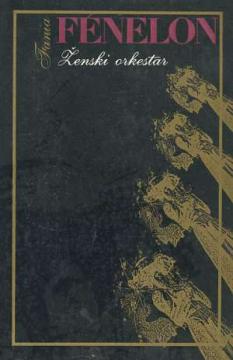
Ženski orkestar
Retka knjiga

Ženski orkestar

Fania Fenelon

Fanie Fénelon's novel The Women's Orchestra is a memoir that describes her experience of surviving in a women's orchestra at the Auschwitz-Birkenau concentration camp during World War II.

Fania, born Fanny Goldstein, a Parisian cabaret singer and member of the Resistance, was arrested in 1943 as a Jew and deported to Auschwitz and later to Bergen-Belsen. In the Birkenau camp, under the number 74862, she joined a women's orchestra led by Alma Rosé, Gustav Mahler's niece.

The orchestra, made up of women of various nationalities, played for the SS and prisoners, often under duress, in order to survive. Fania, a pianist and singer, describes the horrors of the camp - death, humiliation, hunger - but also the dark humor, love, hatred and solidarity among the members of the orchestra. The novel explores moral compromises, tensions between prisoners, including the anti-Semitism of some Polish women, and complex relationships with Nazis, such as Dr. Mengele. Music becomes a means of survival, but also a source of spiritual resistance.

Fénelon writes without pathos, with humor and sincerity, recording trauma and strength of spirit. Although some members of the orchestra, such as Anita Lasker-Wallfisch, challenged her portrayal of Alma Rosé and the dynamics in the orchestra, the work remains a powerful document on the Holocaust, translated into multiple languages and adapted into the film Playing for Time (1980).

Naslov originala
Sursis pour l'orchestre
Prevod
Višnja Machiedo
Urednik
Mirjana Buljan
Dimenzije
20 x 14 cm
Broj strana
372
Izdavač
Globus, Zagreb, 1985.
 
Latinica. Tvrde korice s omotom.
Jezik: Hrvatski.

Jedan primerak je u ponudi

Stanje:Korišćeno, u odličnom stanju
Dodato u korpu!
 

Zanima Vas i neka druga knjiga? Možete pretražiti našu ponudu pomoću pretrage ili prelistati knjige po kategorijama.

Možda će Vas zanimati i ovi naslovi

Osvajači

Osvajači

Andre Malraux

"The Conquerors" by Andre Malraux is a novel about revolutionaries, idealists, and adventurers in China in the 1920s, where the relationship between ideals, power, and human destiny is explored through political struggle, conflicts, and personal motives.

Naklada Binoza, 1932.
Hrvatski. Latinica. Tvrde korice s omotom.
5,32 - 5,42
Most na reci Kvaj / Dželat

Most na reci Kvaj / Dželat

Pierre Boulle

The Bridge on the River Kwai (1952) is a famous story about British prisoners who, under pressure from the Japanese, build a bridge in the jungle. The Executioner (1954) is a philosophical novella about a Chinese executioner who becomes a victim of his ow

Minerva, 1960.
Srpski. Latinica. Tvrde korice.
4,26
Ranjeni pejzaž

Ranjeni pejzaž

Vladimir Mičetić

A book by Vladimir Mičetić, a doctor and volunteer of the Homeland War from Kutina. The work was awarded the literary prize "We Were the First When It Was Necessary" for 2010, awarded by the Association of Croatian Homeland War Veterans.

Spiritus Movens, 2010.
Hrvatski. Latinica. Tvrde korice.
11,52
Sanjaj nemogući san

Sanjaj nemogući san

Johannes Mario Simmel

From the bestselling author of "Jimmy and the Rainbow," comes a novel that weaves a love story with the stirring events of the Bosnian war. This story, woven into the historical context, reminds us that sometimes the impossible dream is the only one worth

Mozaik knjiga, 1997.
Hrvatski. Latinica. Tvrde korice.
7,42
Tri ratna druga

Tri ratna druga

Erich Maria Remarque

Germany after World War I. Three inseparable war comrades struggle to survive amid poverty and inflation. In the chaos, one of them finds great love – but time is against them.

Minerva, 1954.
Srpski. Latinica. Tvrde korice.
4,56
Romeo, Julija i tama

Romeo, Julija i tama

Jan Otčenášek

In occupied Prague in 1942, the student Pavel hides the wounded Jewish woman Hana. In danger and fear, a strong love is born between them. The Gestapo discovers them, Pavel dies tortured under investigation, and Hana survives the Holocaust carrying the me

Svjetlost, 1965.
Srpski. Latinica. Broširano.
3,26