Andrija Kačić-Miošić
Andrija Kačić Miošić (Brist near Makarska, 1704 – Zaostrog, December 15, 1760) was a Croatian poet, Franciscan friar, and popular educator—one of the most influential authors in 18th-century Croatian literature. His surname is correctly spelled "Miošić." He received his initial education at the Franciscan monastery in Zaostrog, and, according to recent research, completed his studies in philosophy and theology in Osijek. He taught philosophy and theology in Zaostrog and Šibenik, and also served in Sumartin on the island of Brač. He spent his final years in Zaostrog.
His literary work is characterized by an effort to bring historical and moral knowledge to people who lacked access to scholarly literature. He wrote in an accessible vernacular—specifically the štokavian-ikavian dialect—drawing upon the expressive devices of oral tradition. His work weaves together historical memory, heroic poetry, and educational instruction.
His most significant work, Razgovor ugodni naroda slovinskoga ("Pleasant Discourse of the Slavic People"), was published in Venice in 1756, with a substantially expanded edition appearing in 1759. The first edition contains 41 poems, while the second contains 136. Through both verse and prose, he recounts the history of the South Slavic and neighboring peoples, with a particular focus on the wars against the Ottomans. The poems are composed primarily in the epic decasyllabic meter, and the narrative persona of "Starac Milovan" (Old Man Milovan) became so closely associated with the author that the two are virtually identified as one. The book, known as the "Pismarica" (Songbook), gained exceptional popularity; some of the poems were adopted and transmitted as folk songs.
Kačić also published a Latin philosophical handbook, Elementa peripathetica (1752), as well as Korabljica (1760)—a prose chronicle covering both biblical and secular history. His body of work bridges the learned Franciscan tradition with the needs of a broad readership.
The influence of Kačić’s poetry extended beyond Croatia’s borders: his poems attracted the attention of European Pre-Romantic and Romantic writers. Numerous editions and a robust oral tradition established him as a pivotal figure in Croatian folk literature and cultural integration.
Titles in our offer

PSHK #21: Andrija Kačić Miošić

Razgovor ugodni naroda slovinskoga
"Conversation of the Pleasant People of Slovenia" is the book that was most often published before the national revival. It went through as many as seven editions until 1826, and for this reason it can be said that it is a true Croatian bestseller.
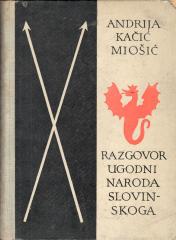
Razgovor ugodni naroda slovinskoga
Historical narratives and heroic poems explore the past of South Slavic and neighbouring peoples, combining oral tradition, epic verse and popular education.