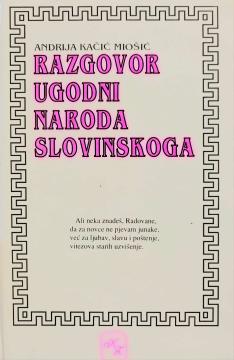
Razgovor ugodni naroda slovinskoga

Razgovor ugodni naroda slovinskoga

Andrija Kačić Miočić

"Conversation of the Pleasant People of Slovenia" is the book that was most often published before the national revival. It went through as many as seven editions until 1826, and for this reason it can be said that it is a true Croatian bestseller.

The author chose events from "Slovenian" or national, but also anti-Turkish history as his topic. He shaped the verse into ten verses that come from folk, oral poetry and that are understandable to anyone who speaks the Croatian language and is not too poetically oriented.

He dedicated the songs to fiddlers, and even then he believed that due to their content, they would probably become popular among the people. He conveyed moral and historical messages to the Dalmatian people that helped them become politically aware and understand their ethnicity.

The author's words can be seen at least in the work, he is more hidden, and in the foreground as an ideologue or educator, adapting the work to the time in which it was created. He believes that he provided his people with a credible work that they could achieve a self-awareness that was difficult to achieve with the songs of the time because they were not true.

Editor
Blaženka Mujačić
Dimensions
20 x 14 cm
Pages
277
Publisher
Katarina Zrinska, Zagreb, 1996.
 
Latin alphabet. Hardcover.
Language: Croatian.

One copy is available

Condition:Used, excellent condition
 

Are you interested in another book? You can search the offer using our search engine or browse books by category.

You may also be interested in these titles

Judita

Judita

Marko Marulić

Judith is an epic poem by Marko Marulić, written in 1501 and printed in 1521. It is considered the first artistic epic in the Croatian language. The work is written in the Chakavian dialect and in doubly rhymed twelve-line stanza.

Hanza Media, 2021.
Croatian. Latin alphabet. Paperback.
3.16
Svjetionik

Svjetionik

Joža Horvat

An interesting novel about the fateful contact between man and the sea. In the center of the plot is the boy Tonko, with an extremely vivid imagination, who in the sensitive period of puberty and family crisis is influenced by dreams of the sea.

Naklada Ljevak, 2000.
Croatian. Latin alphabet. Hardcover.
5.24
Hrvatska gibanica

Hrvatska gibanica

Josip Pavičić
Znanje, 1986.
Croatian. Latin alphabet. Paperback.
5.99
Matoš

Matoš

Miroslav Šicel
Panorama, 1966.
Croatian. Latin alphabet. Hardcover with dust jacket.
5.34 - 8.50
Posljednji vitezovi

Posljednji vitezovi

Simo Matavulj
Sloga, 1957.
Croatian. Latin alphabet. Paperback.
2.98
Diploma za smrt 2

Diploma za smrt 2

Zoran Bručić
CAPITOL FESTIVAL d.o.o., 2017.
Croatian. Latin alphabet. Paperback.
7.99