Georg Wilhelm Friedrich Hegel
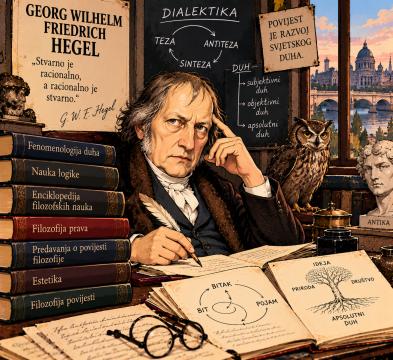
Georg Wilhelm Friedrich Hegel (Stuttgart, August 27, 1770 – Berlin, November 14, 1831) was a German philosopher, one of the most important representatives of German idealism and among the most influential thinkers in modern philosophy. His system encompasses logic, metaphysics, and the philosophies of history, law, religion, art, and politics.
He studied theology and philosophy at the University of Tübingen, where he befriended the philosopher Friedrich Hölderlin and the future philosopher Friedrich Wilhelm Joseph Schelling. After working as a private tutor, he taught in Jena, Heidelberg, and Berlin, where he achieved great academic renown.
His first major work, The Phenomenology of Spirit (1807), traces the development of consciousness from immediate experience to absolute knowledge. It includes the famous discussion of the master and slave, which became significant for later social and historical philosophy.
In The Science of Logic (1812–1816), Hegel develops a system of concepts and their internal movement, while the Encyclopedia of the Philosophical Sciences (1817) provides an overview of his philosophy of logic, nature, and spirit. In Elements of the Philosophy of Right (1821), he examines freedom, morality, civil society, and the state.
Dialectics occupies a central place in his thought—a concept whereby ideas and historical forms develop through internal contradictions and their resolution. Hegel views history as a process of the gradual realization of freedom.
His lectures, published posthumously, include Lectures on the Philosophy of History, Lectures on Aesthetics, Lectures on the Philosophy of Religion, and Lectures on the History of Philosophy.
Hegel's philosophy profoundly influenced Karl Marx, Søren Kierkegaard, Friedrich Engels, and numerous subsequent philosophical movements. His understanding of history, society, and the relationship between thought and reality remains a key cornerstone of contemporary philosophy.
Titles in our offer

Istorija filozofije
A monumental overview of the development of philosophical thought from ancient Greece to German idealism. Hegel interprets the history of philosophy as a unified process of the development of reason, truth, and the human spirit.