Georg Lukacs
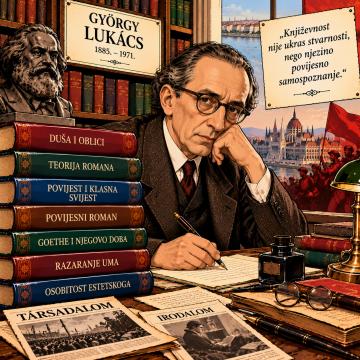
György Lukács (also known as Georg Lukács), a Hungarian philosopher, literary critic, aesthetician, and political theorist, was born on April 13, 1885, in Budapest, where he died on June 4, 1971. He is considered one of the most influential Marxist thinkers of the 20th century, particularly significant for the development of philosophy, the sociology of literature, and the theory of realism.
He came from a wealthy Jewish family. He studied law and philosophy in Budapest, Berlin, and Heidelberg, where he became acquainted with leading European intellectual circles. His early development was influenced by Georg Simmel, Max Weber, and German classical philosophy.
In the work Soul and Form (1911), he explores the relationship between art, life, and human existence. The book The Theory of the Novel (1916) is one of his most important early works; in it, he interprets the novel as the literary form of the modern world—a world marked by a loss of wholeness, alienation, and a search for meaning.
In 1918, he joined the Communist Party of Hungary, and in 1919, he participated in the revolutionary government of the Hungarian Soviet Republic. Following its collapse, he lived in exile, residing in cities such as Vienna, Berlin, and Moscow. His most famous philosophical work, History and Class Consciousness (1923), presents an analysis of reification, class consciousness, and the social totality, exerting a powerful influence on Western Marxism and later critical theory.
In the field of literary theory, he focused particularly on realism and the historical novel. Key works include The Historical Novel (1937/1947), Goethe and His Age (1947), The Young Hegel (1948), and The Destruction of Reason (1954). In his writings on literature, he advocated for realism while criticizing certain modernist techniques.
In 1956, he participated in Imre Nagy’s reformist government, subsequently facing political persecution. In his later years, he worked on the extensive studies The Specificity of the Aesthetic (1963) and The Ontology of Social Being (published posthumously).
Lukács’s thought is characterized by the dialectical method, historicity, social critique, and the philosophy of art. His legacy remains a subject of debate due to his relationship with Stalinism, yet it also endures through his lasting influence on Marxist philosophy, aesthetics, and literary criticism.
Naslovi u ponudi
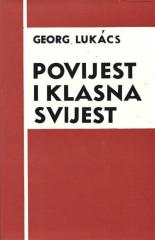
Povijest i klasna svijest: Studije o marksističkoj dijalektici
A 1923 book by the Hungarian philosopher György Lukács, in which the author emphasizes the influence of the philosopher Georg W. F. Hegel on Karl Marx, and analyzes the concept of "class" and attempts to offer a philosophical justification for Bolshevism.