Charles de Montesquieu
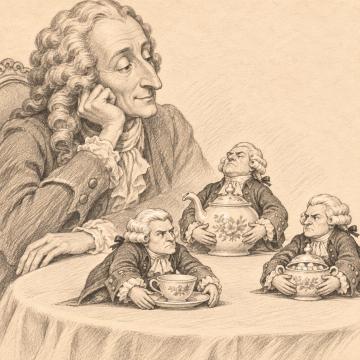
Montesquieu might have had a question for the man in charge of the teapot, the cups and the sugar. Who can tell him when to stop? At the table it’s a matter of taste. In government it’s a matter of liberty. Charles-Louis de Secondat, Baron de Montesquieu (La Brède near Bordeaux, 1689 – Paris, 1755), studied law and held judicial office in Bordeaux. He travelled through Europe, spent time in England and compared the political habits of countries where people could use much the same words and mean quite different things.
He made his name with Persian Letters (Lettres persanes, 1721), first published anonymously. Its two fictional Persian travellers, Usbek and Rica, write about life in Europe. Their observations on Parisian fashion, religion and government have a way of sounding like questions a host would rather skip. Why does a custom everyone takes for granted suddenly need so much explaining when a stranger turns up? As the travellers puzzle over the French, letters from Usbek’s household show how quickly his open-mindedness wears thin when his own authority is challenged.
In Considerations on the Causes of the Greatness of the Romans and Their Decline (Considérations sur les causes de la grandeur des Romains et de leur décadence, 1734), Montesquieu follows Rome’s rise through its institutions and military successes and asks how expansion changed its political life. In The Spirit of the Laws (De l’esprit des lois, 1748), he considers laws in relation to the customs, economies and circumstances that gave rise to them. His best-known argument concerns legislative, executive and judicial power. When authority is distributed so that one branch can restrain another, citizens have less reason to fear arbitrary rule.
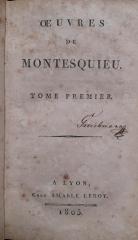
In the 1805 French edition of his collected works listed in Arka’s catalogue, volume four concludes The Spirit of the Laws and volume five contains Persian Letters. One asks how power can be kept within bounds. The other shows how people behave when they’re used to setting the bounds for everyone else. Either goes well with a cup of tea, assuming the people in charge can agree to pour it.
Naslovi u ponudi
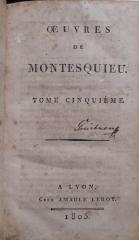
Oeuvres de Montesquieu - tome cinquieme: Lettres Persanes
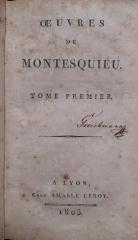
Oeuvres de Montesquieu - tome premier: Esprit des Loix

Oeuvres de Montesquieu - tome quatrieme: Esprit des Loix
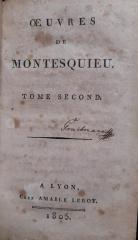
Oeuvres de Montesquieu - tome second: Esprit des Loix

Oeuvres de Montesquieu - tome septieme: Lettres familieres
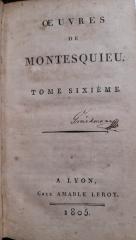
Oeuvres de Montesquieu - tome sixieme: Grandeur des Romains