Branislav Nušić
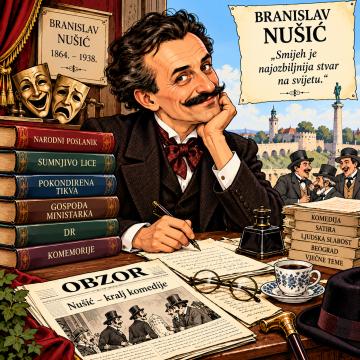
Branislav Nušić (1864–1938)—born Alkibijad Nuša—was a Serbian writer, playwright, novelist, journalist, and diplomat. He was born on October 20, 1864, in Belgrade, where he also died on January 19, 1938. He is considered one of the greatest playwrights in South Slavic literature, renowned for his sharp satire, vivid characters, and witty portrayal of societal flaws.
He was educated in Smederevo and Belgrade, where he completed his law studies. As a young man, he took part in the Serbo-Bulgarian War of 1885, and he was later sentenced to prison for the satirical poem Dva raba (Two Servants), in which he criticized the authorities. Subsequently, he worked in the diplomatic service—primarily within the Ottoman Empire—and held positions in various theatrical and cultural institutions.
He began his literary career with the comedy Narodni poslanik (The Member of Parliament), written in 1883, in which he satirizes political corruption, electoral manipulation, and the struggle for social status. This was followed by the comedies Sumnjivo lice (A Suspicious Person), Protekcija (Patronage), and Običan čovek (An Ordinary Man), works that expose bureaucracy, hypocrisy, and the petty-bourgeois mentality.
The pinnacle of his creative output consists of the comedies The Cabinet Minister's Wife (1929), Mister Dollar (1932), The Bereaved Family (1934), Dr (1936), and The Deceased (1937). In these works, Nušić masterfully portrays greed, vanity, social pretense, and the absurdity of attitudes toward money and power.
A special place is held by his humorous Autobiography (1924), in which he wittily describes his childhood, schooling, and youthful experiences. He also wrote novels, short stories, and travelogues, as well as dramas of a more serious tone, most notably It Had to Be So and The Foundling.
His prose and dramatic works are characterized by dynamic dialogue, situational comedy, irony, and an excellent understanding of human psychology. Nušić was particularly successful in crafting characters such as civil servants, politicians, upstarts, and middle-class families, thereby revealing the universal weaknesses of society.
Thanks to their timeless humor and sharp social criticism, his comedies remain among the most frequently performed works in the region's theater repertoire to this day.
Titel im Angebot
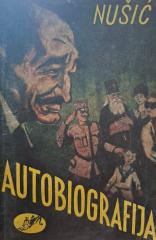
Autobiografija
Branislav Nušić, čuveni srpski komediograf, napisao je svoju autobiografiju koja nas vodi kroz njegov životni put. Kroz oči Nušića, pratimo njegov put od skromnog detinjstva do uspešne književne karijere, prožet humorom i ironijom.
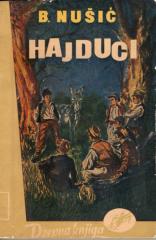
Hajduci
Der Roman Hajduci von Branislav Nušić ist eine humorvolle Geschichte über eine Gruppe Jungen aus einer Kleinstadt, die, inspiriert von Geschichten über Rowdys, ihre eigene Gruppe gründeten und in allerlei Unfug gerieten.
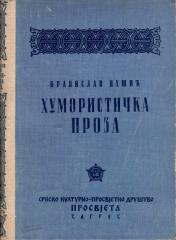
Humoristička proza
Humoristička proza objedinjuje Nušićeve autobiografske, esej-serijske i narativne tekstove, u kojima humor i satira razotkrivaju školu, društvo, vlast i ljudske slabosti.
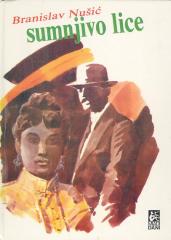
Sumnjivo lice
Delo prikazuje svakodnevne ljudske slabosti i apsurdne situacije kroz humorističnu kritiku društva i karaktera.
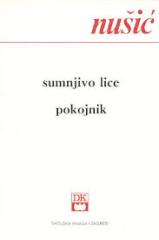
Sumnjivo lice / Pokojnik
U komediji „Sumnjivo lice“ Nušić ismejava tadašnje društvo sa svim manama koje vidi u vlasti pod vlašću dinastije Obrenović. Komedija „Pokojnik” je poslednja komedija koju je Nušić napisao u 70. godini, sa sličnom tematikom.