Heraklit
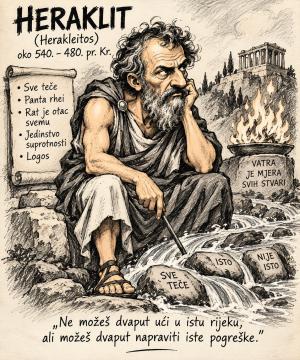
Heraclitus of Ephesus (Greek: Hērákleitos, c. 535 – c. 475 BC) was an ancient Greek pre-Socratic philosopher, one of the most significant thinkers of early Greek philosophy, and a founder of the dialectical understanding of reality. He was born in Ephesus, a Greek city in Asia Minor, likely into an aristocratic family. Little reliable information about his life has survived; ancient tradition describes him as a solitary, critical, and enigmatic thinker, which earned him the nickname "the Obscure" (Skoteinós).
At the heart of Heraclitus’s philosophy lies constant change as the fundamental characteristic of reality. His teaching is traditionally summarized by the phrase pánta rheî ("everything flows"), although this specific formulation is not literally attested in the surviving fragments. His well-known idea regarding the impossibility of stepping into the same river twice expresses the view that the world is in a state of constant flux, yet maintains a certain order.
Heraclitus held that the world is governed by the logos—a universal principle of order, measure, and law—which most people fail to comprehend. He placed particular emphasis on the unity and conflict of opposites, arguing that the harmony of the world is achieved through the tension between opposing forces. He viewed fire as the primary symbol of cosmic change, transformation, and perpetual motion.
His only known work, traditionally titled On Nature (Perì phýseōs), has not survived in its entirety. We know of it through fragments and citations found in later ancient authors, including Aristotle, Plutarch, Clement of Alexandria, and Hippolytus of Rome. According to ancient tradition, the text addressed cosmological, political, and theological issues, and was characterized by an aphoristic, metaphorical, and deliberately enigmatic style.
Heraclitus’s philosophy exerted a profound influence on Plato, Aristotle, the Stoics, Hegel, Nietzsche, and Heidegger, particularly through his understanding of change, contradiction, and the relationship between unity and multiplicity. His doctrine of the logos and the conflict of opposites remains one of the fundamental starting points for Western ontology and dialectical thought.