Miodrag Pavlović
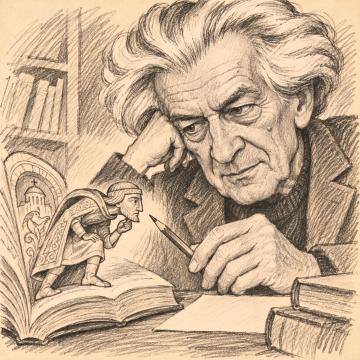
Miodrag Pavlović (Novi Sad, 1928 – Tuttlingen, 2014) published his first book of poetry while still studying medicine. 87 pesama (1952) brought unsettling images of violence, anxiety and loneliness into postwar Serbian verse. Pavlović was interested in what people can do to others and to themselves, and his short, compressed lines gave readers room to connect the images for themselves. That book and its successor, Stub sećanja (1953), are regarded as turning points in Serbian modernism.
He grew up in Belgrade, where he graduated in medicine in 1954 and worked as a doctor. He then briefly led the drama company at the National Theatre and worked as an editor at the publishing house Prosveta from 1961 to 1984. He was a full member of the Serbian Academy of Sciences and Arts. He also wrote fiction, plays and essays and worked as a translator.
In collections such as Mleko iskoni, Velika Skitija and Svetli i tamni praznici (1971), his poetry turns to myth, ritual and historical memory. A scene of sacrifice or an old festival raises questions about how a community remembers its dead and what meaning it gives to its customs. He returned to ritual as an essayist in Poetika žrtvenog obreda (1987).
In 1964 he edited Antologija srpskog pesništva (XIII–XX vek). By placing medieval texts alongside more recent poetry, he broadened the historical frame in which Serbian lyric poetry was read. His choices prompted debate about what belongs to a poetic tradition and how its works should be judged.
Pavlović’s work also includes the short-story collection Most bez obala (1956), the play Igre bezimenih (1963), and the essay collections Osam pesnika (1964) and Poezija i kultura (1974). In his poems, essays and anthologies, he returned to a question: what can we still hear in texts written in a world whose customs we have forgotten?
Titel im Angebot

87 pesama
A poetic rebellion against fear, violence and despair. In 87 poems, Miodrag Pavlović explores the trauma of war, human isolation and the search for hope in a world stripped of certainty.