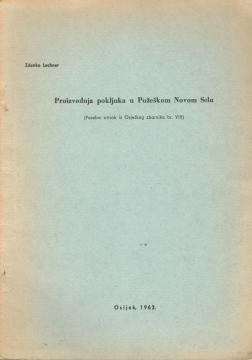
Proizvodnja pokljuka u Požeškom Novom Selu: Separat
Ein rares Buch

Proizvodnja pokljuka u Požeškom Novom Selu: Separat

Zdenka Lechner

Zdenka Lechner, the first ethnologist at the Museum of Slavonia (1951–1965), made significant contributions to the study of the traditional culture of Slavonia, including the use of pokljuc – earthen lids for baking bread and pastries on the hearth.

In Požeško Novo Selo, a village in Požeško-Slavonia County, poključi were traditionally used for baking on a hearth. Made of clay, these lids allowed for even baking of bread, cakes and other pastries, preserving heat and moisture. The process involved heating the poključi over a fire, placing the dough under it and covering it with embers. Lechner documented similar customs, recording the use of the tools and their social significance in rural communities. Poključi were an integral part of Slavonian cuisine, symbolizing household and community.

Through her work at the Museum of Slavonia, Lechner founded the Ethnographic Department (1952) and collected data on agriculture, crafts and culinary traditions. Her records often included interviews with local residents, preserving knowledge of traditional techniques. Today, poključi are used less frequently in Požeško Novo Selo, but they remain part of the cultural heritage, revived through ethnological projects and gastro-tourism.

Maße
24 x 17 cm
Seitenzahl
24
Verlag
Muzej Slavonije, Osijek, 1962.
 
Latein Schrift. Taschenbuch.
Sprache: Kroatisch.

Angeboten wird ein Exemplar

Zustand:Gebraucht, in ausgezeichnetem Zustand
Zum Warenkorb hinzugefügt!
 

Interessieren Sie sich für ein anderes Buch? Sie können das Angebot über unsere Suchmaschine suchen und finden oder Bücher nach Kategorien durchsuchen.

Diese Titel könnten Sie auch interessieren

Komunizam i čovjek: Odnos vlasti i pojedinca u Hrvatskoj (1958.–1972.)

Komunizam i čovjek: Odnos vlasti i pojedinca u Hrvatskoj (1958.–1972.)

Josip Mihaljević

Josip Mihaljević's book analyzes the relationship between the government and the individual in communist Croatia (1958–1972), through repressive mechanisms, ideological pressures, and restrictions on personal freedom in the socialist system.

Hrvatski institut za povijest, 2016.
Kroatisch. Latein Schrift. Hardcover.
17,26
Dnevnik Diarium, svezak 1 (1801 - 1809)

Dnevnik Diarium, svezak 1 (1801 - 1809)

Maksimilijan Vrhovac
Kršćanska sadašnjost, 1987.
Kroatisch. Latein Schrift. Fester Einband mit Schutzumschlag.
16,98
Branimirova Hrvatska u pismima pape Ivana VIII.

Branimirova Hrvatska u pismima pape Ivana VIII.

Mate Zekan
Književni krug, 1989.
Kroatisch. Latein Schrift. Taschenbuch.
4,39
Teorijski osnovi slobodne razmjene rada

Teorijski osnovi slobodne razmjene rada

Ivan Mecanović
Konferencija SKH Zajednice općina - Centar za idejno-teorijski rad, 1985.
Kroatisch. Latein Schrift. Taschenbuch.
0,98
1990. - 2000. Račun molim

1990. - 2000. Račun molim

Goran Matovac
Vlastita naklada, 1999.
Kroatisch. Latein Schrift. Taschenbuch.
3,24
Osječka groblja

Osječka groblja

Stjepan Sršan

The book is deeply rooted in the local history and culture of Osijek, with an emphasis on cemetery motifs that serve as a metaphor for memory, death, and disappearance.

Povijesni arhiv u Osijeku, 1996.
Kroatisch. Latein Schrift. Taschenbuch.
5,26