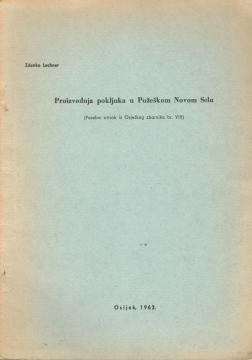
Proizvodnja pokljuka u Požeškom Novom Selu: Separat
Rare book

Proizvodnja pokljuka u Požeškom Novom Selu: Separat

Zdenka Lechner

Zdenka Lechner, the first ethnologist at the Museum of Slavonia (1951–1965), made significant contributions to the study of the traditional culture of Slavonia, including the use of pokljuc – earthen lids for baking bread and pastries on the hearth.

In Požeško Novo Selo, a village in Požeško-Slavonia County, poključi were traditionally used for baking on a hearth. Made of clay, these lids allowed for even baking of bread, cakes and other pastries, preserving heat and moisture. The process involved heating the poključi over a fire, placing the dough under it and covering it with embers. Lechner documented similar customs, recording the use of the tools and their social significance in rural communities. Poključi were an integral part of Slavonian cuisine, symbolizing household and community.

Through her work at the Museum of Slavonia, Lechner founded the Ethnographic Department (1952) and collected data on agriculture, crafts and culinary traditions. Her records often included interviews with local residents, preserving knowledge of traditional techniques. Today, poključi are used less frequently in Požeško Novo Selo, but they remain part of the cultural heritage, revived through ethnological projects and gastro-tourism.

Dimensions
24 x 17 cm
Pages
24
Publisher
Muzej Slavonije, Osijek, 1962.
 
Latin alphabet. Paperback.
Language: Croatian.

One copy is available

Condition:Used, excellent condition
 

Are you interested in another book? You can search the offer using our search engine or browse books by category.

You may also be interested in these titles

Štrajk glađu

Štrajk glađu

Božo Rudež
Tonimir, 1995.
Croatian. Latin alphabet. Paperback.
3.98 - 3.99
Pregled povijesti hrvatskoga naroda

Pregled povijesti hrvatskoga naroda

Ferdo Šišić
Nakladni zavod Matice hrvatske, 1975.
Croatian. Latin alphabet. Hardcover with dust jacket.
9.32 - 11.76
S tradicionalnih na nove puteve: Trgovina, obrt, industrija i bankarske ustanove grada Osijeka na prijelazu stoljeća od 1868. do 1918. godine

S tradicionalnih na nove puteve: Trgovina, obrt, industrija i bankarske ustanove grada Osijeka na prijelazu stoljeća od 1868. do 1918. godine

Zlata Živaković-Kerže

The book explores the economic development of Osijek after the Croatian-Hungarian Settlement until the end of World War I. Osijek, as an important center of Slavonia, experienced a significant economic boom thanks to its location on the Drava River and th

Hrvatski institut za povijest, 1999.
Croatian. Latin alphabet. Hardcover.
7.325.12
Đakovačke ulice

Đakovačke ulice

Borislav Bijelić
Muzej Đakovštine, 1998.
Croatian. Latin alphabet. Paperback.
7.36
O kraljevstvu Dalmacije i Hrvatske

O kraljevstvu Dalmacije i Hrvatske

Ivan Lučić-Lucius

The life work of Ivan Lučić and the debut of Croatian historiography (first printed in 1666 in Amsterdam). The work appears for the first time in the form the author intended, with the author's corrections and additions as well as critical treatment of in

Biblioteka Latina & Graeca, 1986.
Croatian. Latin alphabet. Paperback.
18.24
Locirati, identificirati, uhititi, transferirati: Izdajnici i sluge

Locirati, identificirati, uhititi, transferirati: Izdajnici i sluge

Journalist Milan Ivkošić said that the book contains texts by authors who differ ideologically and that some of them do not share Glavaš's views, but, as he maintains, wrote objectively about his case.

HVIDR-a, 2007.
Croatian. Latin alphabet. Hardcover.
6.98