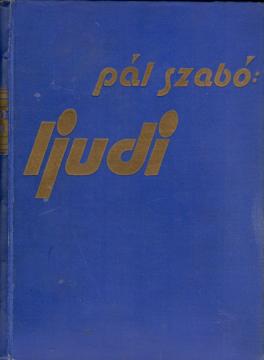
Ljudi
Antiquität

Ljudi

Pal Szabo

„Ljudi“ Pala Saba je romantizovana hronika jedne seoske zajednice u kojoj se, kroz svakodnevni život, sukobe, rad i međuljudske odnose, prikazuju moralna snaga, slabosti i stalna borba čoveka za dostojanstvo.

People by Hungarian writer Pál Szabo is a realistic and socially penetrating novel that presents a broad picture of life in a rural community at the turn of the 19th and 20th centuries. The work focuses on ordinary people — peasants, workers, women, young and old — whose lives are marked by hard work, social inequalities, but also a strong sense of community. Szabo depicts the mentality of the rural environment in a classically realistic manner: the struggle for survival, dependence on the land, seasonal rhythms, but also the emotional tensions that arise from close, almost closed coexistence in a small community.

The novel does not have a single central character; instead, the focus is on the entire collective, where individual destinies are intertwined with social changes. In this sense, “People” functions as a kind of panorama of life: it depicts love and jealousies, family disagreements, generational differences, poverty, the pursuit of a better life, and the relationship to tradition. Szabo also highlights the moral dilemmas of the characters, exploring how external circumstances shape human nature and decisions.

The novel's particular value lies in its detailed descriptions of everyday life — from work in the fields to customs, superstitions, and the village as a social organism. The author builds a style that is both simple and poetic, wanting to emphasize that the lives of "little people" are just as worthy of literary depiction as the fates of great heroes.

People is therefore a novel about struggle, endurance, and the moral complexity of ordinary lives, a work that leaves an impression of documentary credibility and deep humanistic empathy for its characters.

Titel des Originals
Emberek regény
Übersetzung
Andrija Kovačević
Maße
20 x 14 cm
Seitenzahl
252
Verlag
Naklada Binoza, Zagreb, 1932.
 
Latein Schrift. Fester Einband mit Schutzumschlag.
Sprache: Kroatisch.

Angeboten wird ein Exemplar

Zustand:Gebraucht, in sehr gutem Zustand
Nachteile/Unannehmlichkeiten:
  • The cover is missing
Reduzierter Preis: 5,624,22
Der Rabatt von 25 % gilt bis zum 20.06.2026 23:59 Uhr
Zum Warenkorb hinzugefügt!
 

Interessieren Sie sich für ein anderes Buch? Sie können das Angebot über unsere Suchmaschine suchen und finden oder Bücher nach Kategorien durchsuchen.

Diese Titel könnten Sie auch interessieren

Knjiga moga oca

Knjiga moga oca

Ethem Mandić

This is a biography about my father made up of memories and mere imagination. History does not exist, and neither do facts. The past is unknown.

OKF d.o.o, 2016.
Kroatisch. Latein Schrift. Taschenbuch.
10,64
Rock Star

Rock Star

Jackie Collins

With the rhythm of rock'n'roll, Jackie Collins takes the reader behind the scenes of the world of fame and fortune, where three music stars — Kruger, Rafaella and Bobby — experience turbulent passions, betrayals and the struggle for success, while ambitio

Mladost, 1990.
Kroatisch. Latein Schrift. Fester Einband mit Schutzumschlag.
9,34
Skandal na simpoziju

Skandal na simpoziju

Pavao Pavličić
Logos, 1985.
Kroatisch. Latein Schrift. Fester Einband mit Schutzumschlag.
4,72 - 4,98
Osuđen na uspjeh

Osuđen na uspjeh

Hans Hellmut Kirst

U ovom djelu prvi put javlja se lik policijskog inspektora Kelera, koji se neuobičajnim metodama bori protiv kriminala.

Prosveta, 1987.
Kroatisch. Latein Schrift. Taschenbuch.
4,98
Pustolovine Toma Sawyera

Pustolovine Toma Sawyera

Mark Twain

Pustolovine Toma Sawyera prvi je pravi realistički dječji roman, ne samo u američkoj nego i u svjetskoj dječjoj književnosti. Najpoznatije Twainovo djelo i omiljeno dječje štivo u kojem je pisac opisao svoje dječačke doživljaje.

Nakladni zavod Hrvatske, 1947.
Kroatisch. Latein Schrift. Hardcover.
16,32
Ljubičice u srijedu

Ljubičice u srijedu

Andre Maurois

André Maurois, francuski pisac poznat po psihološkim romanima i biografijama, u ovom djelu istražuje teme obiteljskih odnosa, ljubavi i unutarnjih sukoba, što je karakteristično za njegov stil.

Svjetlost, 1965.
Kroatisch. Latein Schrift. Taschenbuch.
3,42 - 3,62