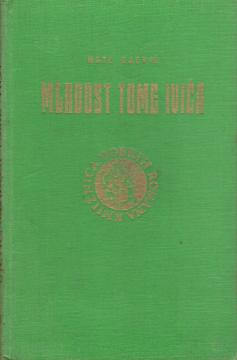
Mladost Tome Ivića
Antiquität
Ein rares Buch

Mladost Tome Ivića

Mate Ujević

The Youth of Toma Ivić (1928) is an autobiographical novel by Mate Ujević. It depicts the spiritual wanderings, youthful crises, and final religious conversion of a sensitive young man in the Herzegovina-Dalmatia setting.

Mate Ujević (1901–1967), a famous Croatian lexicographer, encyclopedist and writer, published the novel Mladost Tome Ivića in 1928 in the edition of the Library of Good Novels of the Croatian Literary Society of St. Jerome. It is his most extensive prose work, which has a strong autobiographical character.

The novel follows the youth of Tome Ivić, a sensitive and intelligent young man from the hinterland of Herzegovina, who goes to school and encounters the challenges of the modern world, city life, ideological conflicts and personal crises. Ujević describes his spiritual wanderings, disappointments in friendship and love, moral dilemmas and finally finding a foothold in the Catholic faith.

The work is written in the spirit of Catholic literature of the interwar period. It emphasizes the themes of religious conversion, the struggle between worldly temptations and spiritual calling, and the conflict between the traditional rural mentality and new ideas. The style is introspective, lyrical and somewhat didactic, with rich descriptions of the Herzegovinian and Dalmatian nature.

Although it was noted in Catholic circles in its time, the novel did not experience great literary reception and was often considered more a document of the times than a work of high art. Today it is valued as an authentic testimony to the youthful crisis of the Croatian Catholic intelligentsia in the 1920s and as a rare antiquarian edition. It represents an important part of Mate Ujević's early work before he devoted himself entirely to lexicographic and encyclopedic work.

Editor
Josip Andrić
Maße
19 x 12,5 cm
Seitenzahl
136
Verlag
Hrvatsko književno društvo Sv. Jeronima, Zagreb, 1928.
 
Latein Schrift. Hardcover.
Sprache: Kroatisch.

Angeboten wird ein Exemplar

Zustand:Ungebraucht
Zum Warenkorb hinzugefügt!
 

Interessieren Sie sich für ein anderes Buch? Sie können das Angebot über unsere Suchmaschine suchen und finden oder Bücher nach Kategorien durchsuchen.

Diese Titel könnten Sie auch interessieren

Magična ljubavna kutijica

Magična ljubavna kutijica

Santa Montefiore

The Magic Love Box (2002) follows the life story of Federica Campione, which begins in Vina del Mar, Chile, in the summer of 1982. Montefiore creates an epic story of growth, where the magic is not only in the box, but in the courage to let go of the past

Mozaik knjiga, 2006.
Kroatisch. Latein Schrift. Hardcover.
7,34
Usta puna zemlje

Usta puna zemlje

Branimir Šćepanović

The novel "Usta puna zemlje" (1970), the masterpiece of the Serbian writer Branimir Šćepanović, is a psychologically in-depth explorer of the limits of the human soul, solitude and existential freedom, reminiscent of Kafka and Camus.

BIGZ, 1987.
Serbisch. Latein Schrift. Taschenbuch.
3,98
Klatno

Klatno

György Konrád

Pendulum draws an inner map of the adventure of self-disclosure - of one's own inclinations, fears, desires, Love - one's own habitus, revealing, as never before, the secrets of the writer's workshop.

Kulturni centar Novog Sada, 2010.
Serbisch. Latein Schrift. Taschenbuch.
6,24
Ljubičice u srijedu

Ljubičice u srijedu

Andre Maurois

André Maurois, a French writer known for his psychological novels and biographies, explores themes of family relationships, love, and internal conflicts in this work, which is characteristic of his style.

Svjetlost, 1965.
Kroatisch. Latein Schrift. Taschenbuch.
3,42 - 3,62
Malena je ime tanga

Malena je ime tanga

Almudena Grandes

If you like raw eroticism like Cloud Atlas, this is a sensual saga – emotional, provocative, for those who want to feel the pulse of forbidden passion! Grandes probes whether love is a curse or a liberation?

Mozaik knjiga, 2000.
Kroatisch. Latein Schrift. Hardcover.
8,54
Proces

Proces

Franz Kafka

Kafka wrote The Process between 1914 and 1915, published posthumously in 1925. The novel is unfinished but with an added final chapter by Max Brod. Edition with a foreword by B. Živojinović and an afterword by Walter Killi.

BIGZ, 1990.
Serbisch. Latein Schrift. Taschenbuch.
4,26