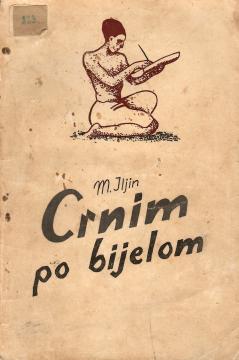
Crnim po bijelom – priče o knjigama
Ein rares Buch

Crnim po bijelom – priče o knjigama

Mihailo J. Iljin

A popular science book for young people about the history of writing, books, and printing — from prehistoric drawings to the modern printing press. A lively, accessible style by a Soviet author with illustrations by N. Lapshin.

The work Black on White by the Soviet author Mikhail Yakovlevich Ilyin (real name Ilya Yakovlevich Marshak, 1896–1953) is a classic of popular science literature for children and young people. Ilyin, brother of the famous poet Samuil Marshak, was a master of writing understandable and interesting books about science and technical progress.

The content follows the history of the book chronologically and thematically: from the first human writings on stones, bones and clay, through Egyptian papyrus, parchment, Chinese paper, medieval manuscripts, illuminated codices, to Gutenberg's invention of the printing press and modern mass production of books. Ilyin vividly describes how each change in material and technique (from drawing "black on white") influenced the spread of knowledge, culture and education. He particularly emphasizes the role of the book in the fight against ignorance and its democratic potential.

The style is dynamic, narrative and full of interesting anecdotes, which is typical of Ilyin's books (Stories about things, Creation of a new world, etc.). Although it was created in the Soviet context, this book is relatively universal and less ideologically burdened than some other works of that era. In post-war Yugoslavia, it fit in well with efforts to popularize knowledge and reading among young people.

Titel des Originals
Чёрным по белому
Übersetzung
Radivoje V. Teodosić
Illustrationen
Nikolaj Ustinovič Lapšin
Maße
20 x 13 cm
Seitenzahl
111
Verlag
Nakladni zavod Hrvatske, Zagreb, 1946.
 
Latein Schrift. Taschenbuch.
Sprache: Kroatisch.

Angeboten wird ein Exemplar

Zustand:Gebraucht, in sehr gutem Zustand
Nachteile/Unannehmlichkeiten:
  • Traces of patina
Zum Warenkorb hinzugefügt!
 

Interessieren Sie sich für ein anderes Buch? Sie können das Angebot über unsere Suchmaschine suchen und finden oder Bücher nach Kategorien durchsuchen.

Diese Titel könnten Sie auch interessieren

Zlatno telešce

Zlatno telešce

Ilja Iljf, Evgenij Petrov

The Golden Calf (1931) follows the ingenious con artist Ostap Bender, who in Soviet Russia during the first five-year plan seeks a secret millionaire in order to get rich, encountering the absurdity of bureaucracy, the new Soviet man, and his own downfall

Naklada Binoza, 1934.
Kroatisch. Latein Schrift. Fester Einband mit Schutzumschlag.
9,74
Sabrana djela A. P. Čehova #7: Seljaci i druge novele

Sabrana djela A. P. Čehova #7: Seljaci i druge novele

Anton Pavlovič Čehov

Between 1892, when "The Fragment", the first novella in this book, was published, and "The Peasant" (1897) and "On the Carts" (1897), A. P. Chekhov made a series of other artistically successful observations of the society in which he lived.

Zora, 1960.
Kroatisch. Latein Schrift. Fester Einband mit Schutzumschlag.
13,62
Ruska čitanka za VI., VII. i VIII razred gimnazije

Ruska čitanka za VI., VII. i VIII razred gimnazije

Rudolf Franjo Poljanec

A school reader from the time of the Federal Republic of Yugoslavia, intended for upper-grade grammar school students, features a selection of Russian literary texts for learning the language, getting to know Russian culture, and developing linguistic and

Nakladni zavod Hrvatske, 1949.
Kroatisch. Latein Schrift. Taschenbuch.
7,32
Ruska šuma

Ruska šuma

Leonid Leonov

The novel follows Boris Kostomarov, an engineer in Soviet Russia, who, through conflicts with bureaucracy, moral questioning, and the fates of people in remote forests, reveals the complexity of Soviet society and the price of personal conscience.

Prosveta, 1960.
Serbisch. Kyrillisch Schrift. Fester Einband mit Schutzumschlag.
6,365,09
Bijedna ljubav Musorgskog

Bijedna ljubav Musorgskog

Ivan Lukaš

Ivan Lukaš's novel depicts the tragic love story of the great Russian composer Modest Mussorgsky. The novel follows his unrequited love, artistic struggle, alcoholism, and decline in 19th-century imperial Russia.

Savremena biblioteka, 1940.
Kroatisch. Latein Schrift. Fester Einband mit Schutzumschlag.
9,24