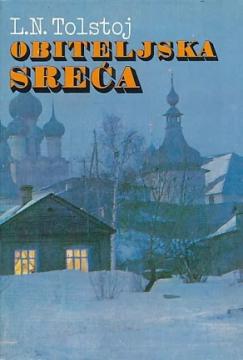

Obiteljska sreća

Obiteljska sreća

Lav Nikolajevič Tolstoj

Family Happiness (1859.) is a significant work of Tolstoy's early work. Unlike his later moralistic works, here Tolstoy offers a tender, intimate story, focused on personal relationships, which makes it unique in his oeuvre.

In 19th-century Russia, seventeen-year-old Masha, after the loss of her parents, feels the weight of loneliness in her country home. Her life is illuminated by the arrival of Sergei Mikhailovich, a family friend and a more mature man, whose presence brings warmth and hope. Family Happiness, one of Leo Tolstoy’s more intimate works, follows Masha’s emotional and spiritual evolution through love and marriage.

Masha falls in love with Sergei, captivated by his wisdom and tenderness. Their relationship blossoms, but marriage brings unexpected challenges. Masha, full of youthful ideals, dreams of a passionate life, while Sergei seeks the peace of country life. Moving to the city further complicates matters: Masha is drawn to the glamour of social circles, while Sergei remains true to simplicity. Their conflicts reveal different perspectives on love and happiness, and Masha goes through an internal struggle between personal desires and family duties. Ultimately, through the birth of children and reconciliation, Masha finds a deeper meaning in family life, realizing that happiness lies in accepting reality, not in romantic ideals.

Family Happiness provides a bridge between his autobiographical works (Childhood, Boyhood, Youth) and his later epics (War and Peace, Anna Karenina). Inspired by Tolstoy's own relationship with Valeria Arsenyeva, the novel explores themes of love, marriage, and female emancipation, anticipating the complex psychological portraits in his later works.

Prevod
Vladimir Babić, Vaso Bogdanov, Zlatko Crnković, Ivan Kušan, Malik Mulić i Roman Šovary
Urednik
Jakša Kušan
Naslovnica
Alfred Pal
Dimenzije
20 x 14 cm
Broj strana
520
Izdavač
Nakladni zavod Matice hrvatske, Zagreb, 1979.
 
Latinica. Tvrde korice s omotom.
Jezik: Hrvatski.

Nema primeraka u ponudi

Poslednji primerak je nedavno prodat.


Zanima Vas i neka druga knjiga? Možete pretražiti našu ponudu pomoću pretrage ili prelistati knjige po kategorijama.

Možda će Vas zanimati i ovi naslovi

Rat i mir 3

Rat i mir 3

Lav Nikolajevič Tolstoj
Nakladni zavod Matice hrvatske, 1979.
Hrvatski. Latinica. Tvrde korice s omotom.
5,98
Rat i mir 2

Rat i mir 2

Lav Nikolajevič Tolstoj
Nakladni zavod Matice hrvatske, 1979.
Hrvatski. Latinica. Tvrde korice s omotom.
5,98
Krivotvoreni kupon i druge pripovijesti

Krivotvoreni kupon i druge pripovijesti

Lav N. Tolstoj

The stories Morning of a Nobleman, From the Notes of Prince Nekhludov, Marker's Notes, The Scale, Two Hussars, The Prisoner of the Caucasus, The Forged Coupon, The Death Notes of Old Man Fyodor Kuzmich, and Why? explore themes of morality, society, and sp

Nakladni zavod Hrvatske, 1979.
Hrvatski. Latinica. Tvrde korice s omotom.
5,62
Šinjel i druge pripovijetke

Šinjel i druge pripovijetke

Nikolaj Gogolj

Die Geschichte Gogols ist eine Geschichte von tragischem Talent, Mystik und Wahnsinn, von einem Manuskript, das verbrannte, von einer Nase und einem Mantel, von einem Zuhörer und toten Seelen.

Civitas, 2004.
Hrvatski. Latinica. Broširano.
6,48
Dijalektika prijelaznog perioda

Dijalektika prijelaznog perioda

Viktor Pelevin

Das Buch stellt die Anthologie des Autors dar – den größten Teil bildet der Roman Čisla (Čisla), gefolgt von der Kurzgeschichte Macedonian Criticism of French Thought und mehreren Kurzgeschichten (Odin vog, Akiko, Fokus-grupa, Gost na prazniku bon).

Disput, 2006.
Hrvatski. Latinica. Broširano.
9,68
Sabrana djela A. P. Čehova #3: Drama u lovu i druge novele

Sabrana djela A. P. Čehova #3: Drama u lovu i druge novele

Anton Pavlovič Čehov

Treći tom Sabranih dela sadrži najobimniju Čehovljevu novelu „Drama u lovu“, kao i niz dužih priča iz perioda 1885-1886. Tu su humoreske poput „Silos u vreći“, „Eh, ta publika“ i „Mnogo papira“, kao i novele poput „Uzvičnik“, „Tuga“ i „Anjuta“.

Zora, 1959.
Hrvatski. Latinica. Tvrde korice s omotom.
8,74