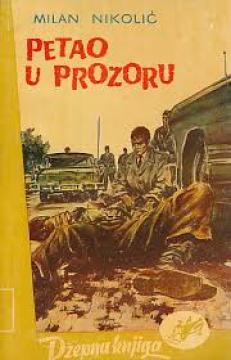
Petao u prozoru
Ein rares Buch

Petao u prozoru

Milan Nikolić

"Rooster in the Window" (1960) is a popular detective and crime novel by Croatian writer Milan Nikolić (Osijek, 1924 – Virovitica, 1970), one of the most widely read authors of post-war entertaining prose in Yugoslavia.

The story takes place in post-war Yugoslavia (probably the 1950s), where a mysterious stranger – an alleged tourist – appears, attracting suspicion due to unusual details. The key motif is a rooster (or a picture of a rooster) in the window of a house, which serves as a signal, symbol or trace from the past. The stranger turns out to be a former member of the Gestapo or a Nazi collaborator who is hiding or returning to retrieve something from the wartime.

Nikolić builds tension through classic crime novel elements: an investigation (perhaps by the police or ordinary people), secret connections, false identities, conflicts of interest and moral dilemmas. The novel has an adventurous flow, with elements of espionage and pursuit, and the rooster in the window becomes a metaphor for a hidden danger or a past that does not pass. The work is known for its record-breaking circulation for that time and inspired ideas for a film adaptation (e.g. Saša Petrović considered a film about a Gestapo tourist).

The style is simple, dynamic, typical of Nikolić's crime novels (similar to "Four Dead Sheriffs", "Ticket to Hell", "Spy X Reports"): fast pace, unexpected twists, criticism of fascism and war crimes through an entertaining form. There is no deep psychology, but action and a moral message about justice and memory of the past. The novel was very popular, translated in the spirit of Yugoslav entertainment literature of the 1950s-1960s, and recently republished (Vedis, 2025). One of the classic works of domestic crime fiction of that period.

Editor
Risto Trifković
Titelseite
Mirko Stojnić
Maße
16,5 x 11 cm
Seitenzahl
231
Verlag
Svjetlost, Sarajevo, 1960.
 
Latein Schrift. Taschenbuch.
Sprache: Serbisch.

Angeboten wird ein Exemplar

Zustand:Ungebraucht
Zum Warenkorb hinzugefügt!
 

Interessieren Sie sich für ein anderes Buch? Sie können das Angebot über unsere Suchmaschine suchen und finden oder Bücher nach Kategorien durchsuchen.

Diese Titel könnten Sie auch interessieren

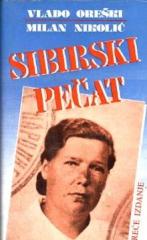
Sibirski pečat

Sibirski pečat

Vlado Oreški, Milan Nikolić

Memoirs of Agata Oreški (1906-1991), a Croatian revolutionary and the only woman from Yugoslavia to survive Stalin's concentration camps. The book was compiled by her son Vlado Oreški and Milan Nikolić, with a foreword by Slavko Goldstein.

Sveučilišna naklada Liber (SNL), 1983.
Kroatisch. Latein Schrift. Fester Einband mit Schutzumschlag.
4,963,72 - 5,44
Reč odbrane

Reč odbrane

Milan Nikolić
Svjetlost, 1961.
Kroatisch. Latein Schrift. Taschenbuch.
4,12
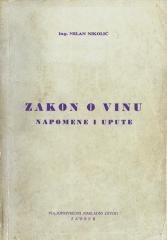
Zakon o vinu: napomene i upute

Zakon o vinu: napomene i upute

Milan Nikolić

The work is primarily intended for lawyers, farmers, winegrowers, winemakers and inspectors who were involved in the production, sale and control of wine.

Poljoprivredni nakladni zavod, 1959.
Kroatisch. Latein Schrift. Taschenbuch.
9,88
Made in U.S.A.

Made in U.S.A.

Goran Tribuson

Imagine Zagreb in the 1980s, where behind the gray facades of apartment buildings lies a dream world of the far West – Hollywood, freedom and endless possibilities. Tribuson, a master of Croatian prose, here combines genres into one fluid story that bites

Znanje, 1986.
Kroatisch. Latein Schrift. Fester Einband mit Schutzumschlag.
5,724,29
Čovjek vrijedan zlata

Čovjek vrijedan zlata

Joseph Heller

Bruce Gold, a literature professor and Jewish man from Brooklyn, is offered a chance to become a high-ranking official in Washington. While trying to write a book about the Jewish experience, he becomes entangled in the absurd world of politics, confronti

Otokar Keršovani, 1987.
Kroatisch. Latein Schrift. Taschenbuch.
Das Buch besteht aus zwei Bänden
6,32
Paralelni svijet

Paralelni svijet

B. D. Benedict

Parallel World is considered Benedikt's boldest and most influential novel, a true pioneering work in which he first publicly presented his "theory of parallel dimensions" which would later become the backbone of his entire oeuvre.

Stari grad, 1997.
Kroatisch. Latein Schrift. Hardcover.
8,226,58 - 8,32