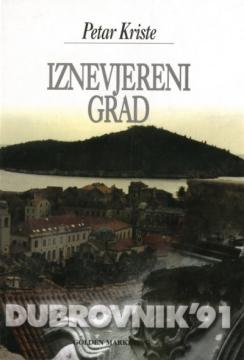
Iznevjereni grad: Dubrovnik 1991
Rare book

Iznevjereni grad: Dubrovnik 1991

Petar Kriste

A memoir by Petar Krista, a member of the Dubrovnik Crisis Staff, about the first months of the siege of the city. The work records the political background, military reality, and personal drama of the defense of Dubrovnik.

The Betrayed City: Dubrovnik 1991 by Petra Kriste is one of the earliest and most authentic testimonies about the beginning of the Homeland War in Dubrovnik. Kriste, born on Šipan in 1936, a politician and publicist, was the first Croatian Minister of Defense and at the beginning of the war a member of the Dubrovnik Crisis Staff. It is precisely this position that gives his book a special documentary weight: he recorded events from the inside, from the perspective of a man who was at once an observer, participant and witness.

The book covers September, October and November 1991, a period in which Dubrovnik remained completely cut off, exposed to attacks by the JNA, Montenegrin and Serbian paramilitary formations. Kriste brings diary entries, interviews, official information, impressions and notes that show how the city tried to defend itself without weapons, logistics and political support. Particularly powerful parts describe the day of the fall of Sustjepan, the shelling of the historic core, the humanitarian crisis and the moral strength of the people of Dubrovnik.

The authenticity of the book stems from several levels: the author is at the very center of political and organizational activity; he cites specific names, events, and decisions; and subsequent trials, including his testimony at the Hague Tribunal, confirm the authenticity of his notes. Kriste speaks openly about the failures, incompetence, and slow reactions of the then leadership, but also about the courage of the defenders and citizens.

The Betrayed City is not only a war diary, but also a chronicle of disappointed expectations — of a city that believed it would be spared, of politicians who expected reason, and of residents who found themselves in a war zone overnight. The memoirs today serve as a valuable historical source about one of the key moments in the defense of Croatia's southern border and the identity of a city under siege.

Editor
Radule Knežević
Graphics design
Luka Gusić
Dimensions
21 x 15 cm
Pages
184
Publisher
Golden marketing, Zagreb, 2000.
 
Latin alphabet. Hardcover.
Language: Croatian.

One copy is available

Condition:Used, excellent condition
 

Are you interested in another book? You can search the offer using our search engine or browse books by category.

You may also be interested in these titles

Izabrani radovi

Izabrani radovi

Ljubo Boban

Selected Works of Academician Ljubo Boban (2022) brings together key texts on contemporary Croatian history of the 20th century. The foreword by Damir Agičić highlights Boban's methodological rigor and objectivity in researching sensitive topics.

Srednja Europa, 2022.
Croatian. Latin alphabet. Hardcover.
24.52
Osječka bibliografija I-II: Tiskarsko-izdavačka djelatnost u Osijeku od 1742. do 1978. godine

Osječka bibliografija I-II: Tiskarsko-izdavačka djelatnost u Osijeku od 1742. do 1978. godine

Marija Malbaša

The capital bibliography of printing and publishing activities in Osijek from 1742 to 1978 lists thousands of books, newspapers, magazines and small print, regardless of language. A classic of Croatian bibliographic creativity of the 20th century.

Jugoslavenska akademija znanosti i umjetnosti (JAZU), 1981.
Croatian. Latin alphabet. Hardcover.
The book consists of two volumes
48.32
Crtice iz slavonske povijesti s osobitim obzirom na prošlost županija: Križevačke, Virovitičke, Požeške, Cisdravske baranjske, Vukovske i Srijemske, te Kr. i slob. grada Osijeka u srednjem i novom vijeku

Crtice iz slavonske povijesti s osobitim obzirom na prošlost županija: Križevačke, Virovitičke, Požeške, Cisdravske baranjske, Vukovske i Srijemske, te Kr. i slob. grada Osijeka u srednjem i novom vijeku

Josip Bösendorfer

In his major work from 1910, Josip Bösendorfer provides an overview of Slavonian history with an emphasis on the past of the counties (Križevci, Virovitica, Požega, Baranja, Vukovo, Srijem) and the city of Osijek in the Middle Ages and the modern era.

Naklada Radoslava Bačića, 1910.
Croatian. Latin alphabet. Hardcover.
86.42
Dan kada je nastala država Hrvatska 1991.

Dan kada je nastala država Hrvatska 1991.

Davorin Rudolf, Vladimir Šeks, Jasna Omejec

The collection brings together scholarly works on key political, legal, and diplomatic processes that led to the creation of the Croatian state in 1991, analyzing the decisions, actors, and international circumstances crucial to independence.

Hrvatska akademija znanosti i umjetnosti (HAZU), 2015.
Croatian. Latin alphabet. Paperback.
17.26
U modi: Kultura odijevanja porečkih plemenitih građana (1650.-1720.)

U modi: Kultura odijevanja porečkih plemenitih građana (1650.-1720.)

Elena Uljančić

The book represents a novelty not only in Istrian, but also in Croatian historiography. Namely, the clothing culture in the region of Istria in the early modern period has not yet been analyzed at all, and for the region of Dalmatia only sporadically.

Srednja Europa, 2019.
Croatian. Latin alphabet. Hardcover.
16.99
Zakon Vinodolski: Uvod, tekst i tumač

Zakon Vinodolski: Uvod, tekst i tumač

Rudolf Strohal

Antikvarno izdanje „Zakon Vinodolski“ koje je 1912. priredio Rudolf Strohal, izvorno objavljeno u „Mjesečniku pravničkog družtva“, predstavlja jedno od najvažnijih hrvatskih filološko‑pravnih izdanja s početka 20. stoljeća.

St. Kugli, 1912.
Croatian. Latin alphabet. Paperback.
22.36