Bal Gandahar Tilak
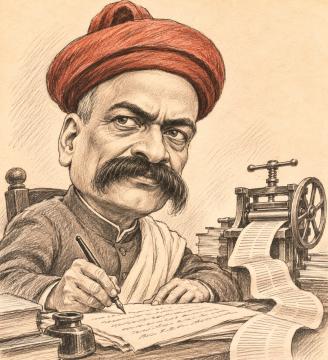
In 1908, the British colonial authorities sentenced Bal Gangadhar Tilak (1856–1920) to six years in prison. One of the most outspoken advocates of Indian self-government found himself in Mandalay, in what is now Myanmar. There he wrote his best-known work, Gita Rahasya. In an ancient Sanskrit poem he found a question that also occupied him as a politician: how should one act when the outcome is uncertain?
Tilak was born in Ratnagiri in western India. He studied mathematics and law in Pune, taught and helped establish educational institutions under Indian leadership. He reached a wider audience through two weeklies he launched with colleagues, the Marathi-language Kesari and the English-language The Mahratta. The papers took debate about British rule beyond political circles to readers in two languages.
Within the Indian National Congress, Tilak pressed for a more assertive pursuit of swaraj, or Indian self-government. After returning from prison, he helped found the Home Rule League in 1916. He died in 1920 in Bombay, now Mumbai. He was also known by the honorific Lokmanya, a sign of the esteem in which he was held by the public.
In The Orion (1893), Tilak tried to date the Vedic texts by interpreting what he took to be astronomical clues. In The Arctic Home in the Vedas (1903), he put forward a speculative theory that the ancestral homeland of the Vedic Aryans lay in the far north. Both books show how far he was willing to go in interpreting India’s oldest texts.
Written in Marathi, Gita Rahasya (1915) reads the Bhagavad Gita as a work about the ethics of action. Tilak emphasises doing one’s duty without attachment to the outcome. Read alongside his newspaper writing, the book shows the same author wrestling with the meaning of duty in an ancient poem and arguing for his contemporaries’ right to govern their own country.
Titles in our offer
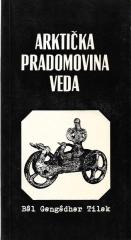
Arktička pradomovina Veda
The book The Arctic Homeland of the Vedas (1903) by the Indian scholar Tilak proposed the hypothesis that the ancient Aryans, the authors of the Rigveda, originated in the Arctic region. Although controversial, the book remains important in the study of V