Georges Simenon
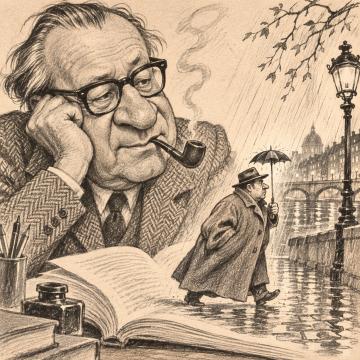
Georges Simenon (Liège, 1903 – Lausanne, 1989) could set a good part of a criminal investigation in a café. While others look for evidence, his Inspector Jules Maigret listens to people talking when they think nobody is questioning them. He notices who sits with whom, what goes unsaid in front of customers and how people behave when their routines are disrupted. Simenon builds suspense from such details and uses them to reveal what life was like before the crime.
He grew up in Liège and began working for La Gazette de Liège in his teens. He covered accidents, crimes and other local events. After moving to Paris, he published short stories and popular novels under numerous pen names. He returned to his memories of his home city in the autobiographical novel Pedigree (1948), a chronicle of a Liège family in the early twentieth century.
The Maigret series began appearing in 1931 with the publisher Fayard. Pietr-le-Letton was among the early titles. In Le Pendu de Saint-Pholien (1931), an investigation leads back to a secret from the youth of a group of friends. Maigret et Monsieur Charles (1972) was the last Maigret novel and the last novel Simenon published in his lifetime.
Alongside the detective series, he wrote psychological novels he called romans durs. Le Bourgmestre de Furnes (1939) follows a man accustomed to running both a town and his own family, until events slip beyond his control. In La Chambre bleue (1964), a love affair is pieced together from memories and statements made under questioning. In Le Chat (1967), years of marital resentment play out in a series of small domestic gestures.
After the Second World War, Simenon lived in North America and later settled in Switzerland. In his later years he turned to autobiographical writing, including Mémoires intimes (1981). From crime reports to family chronicles, he was drawn to the moment when familiar habits reveal something people have long managed to hide, sometimes even from themselves.
Titles in our offer

A Man's Head
Maigret sets out to prove the innocence of a man condemned to death for a brutal murder.

Čovečuljak iz Arhangelska
It was to protect Gina's reputation that Jonas had told the little lie. She had often gone off with younger men since their wedding.

Liberti bar
This crime novel by Georges Simenon follows Commissioner Maigret as he investigates the murder of a wealthy Australian at the Parisian nightclub Liberty Bar, uncovering dark family secrets and suppressed passions.
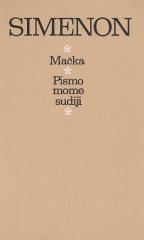

Maigret i žrtva iz Seine
When boatmen rescue a badly injured homeless man from the Seine, Maigret investigates the attack and the past of a former doctor who abandoned his middle-class life.
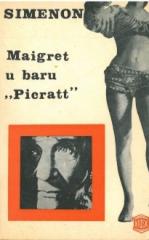
Maigret u baru "Picratt"
Stripper Arlette from Montmartre comes to the police drunk and claims to have heard two men plotting to kill the Countess. She is soon found strangled, followed by the Countess von Farnheim. The 36th novel in the series about Commissioner Jules Maigret.

Megre i barska igračica / Megreov vikend na Seni
A seemingly peaceful weekend by the river turns into an investigation that reveals hidden tensions and motives between people.

Megre i barska igračica / Megreov vikend na Seni
Two detective novels by Georges Simenon in which Inspector Maigret investigates crimes connected to nightlife and riverside entertainment, uncovering secrets beneath seemingly ordinary lives.

Megre i sumnjičavi supružnici / Megre i mali ministrant
Maigret uncovers the truth in a marriage where suspicion and fear have blurred the line between reality and imagination.

Megreov lopov / Megre se boji
Both novels emphasize Simenon's focus on the psychology of the characters and the atmosphere, rather than the crime itself.