Arthur Rimbaud
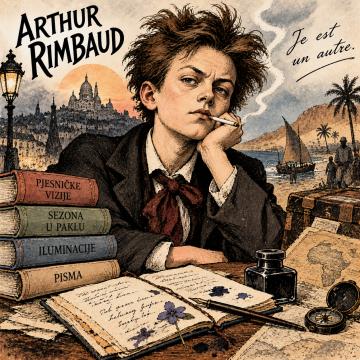
Jean Nicolas Arthur Rimbaud (Charleville, October 20, 1854 – Marseille, November 10, 1891) was a French poet, one of the most significant figures of Symbolism and a pioneer of modern European poetry. He grew up in a strict bourgeois family and demonstrated exceptional literary talent as early as childhood. A rebellious youth, he frequently ran away from home, rejected social conventions, and sought freedom in both his creative work and his life.
He wrote his first poems during adolescence and had already shaped his own poetic style by the age of sixteen. In 1871, he met the poet Paul Verlaine, with whom he shared a tumultuous romantic and creative relationship. They lived together in Paris, Brussels, and London. Their relationship ended in 1873 following a confrontation in which Verlaine wounded Rimbaud with a pistol.
Rimbaud’s most important work, A Season in Hell (Une saison en enfer, 1873), is an autobiographical poetic prose work that explores inner conflict, rebellion, guilt, and the search for identity. The collection Illuminations (Illuminations, 1886) presents visionary poetic imagery, free associations, and experimental expression, thereby exerting a powerful influence on the development of modern literature. Among his most famous poems are The Drunken Boat, Vowels, Asleep in the Valley, and Sensation.
In his famous "Letters of the Seer" (1871), he articulated the concept of the poet as a visionary who attains insight through the systematic derangement of all the senses. His poetics are characterized by synesthesia, symbolism, freedom of expression, rebellion, and exploration of the unconscious. The famous statement "I is someone else" expresses his understanding of the fluid nature of poetic identity.
Around the age of twenty, he abandoned literature almost entirely. He traveled across Europe and later lived in Africa—specifically in Aden and Harar—where he engaged in trade. Due to a severe illness, he returned to France, where he died at the age of thirty-seven.
Although his creative career was brief, Rimbaud became a symbol of poetic rebellion, youthful genius, and radical artistic freedom, exerting a powerful influence on Symbolism, Surrealism, and 20th-century modern poetry.