Marguerite Yourcenar
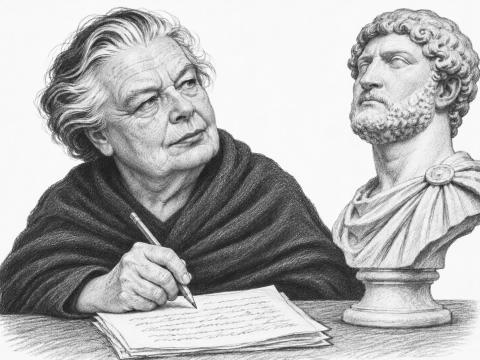
Marguerite Yourcenar has her pencil ready, but Hadrian won’t say a word. Taking dictation from a marble emperor is hard work. Fortunately, in Hadrijanovi memoari she could give him a voice herself.
Born in Brussels in 1903 as Marguerite de Crayencour, she made her pen name by rearranging letters from her family name. She was educated privately and took up writing early. In the short novel Alexis ili rasprava o uzaludnoj borbi (Alexis ou le Traité du vain combat, 1929), a young musician writes to his wife to explain why he is leaving. Already, a letter gives a character room to say what he could never say aloud.
At the beginning of the Second World War, Yourcenar moved to the United States. She spent much of her life on Mount Desert Island in Maine with the translator Grace Frick, her longtime partner. In 1980 she became the first woman elected to the Académie française. She died in Maine in 1987.
In Hadrijanovi memoari (Mémoires d’Hadrien, 1951), the ageing Roman emperor writes to the young Marcus Aurelius. He recalls governing the empire, his travels and his love for Antinous, whose death struck him deeply. The letter lets him reconsider his decisions before a future emperor and admit how much remained beyond his reach, for all his power.
Crna mijena (L’Œuvre au noir, 1968) centres on Zeno, a fictional Renaissance physician and alchemist. His curiosity carries him beyond the limits imposed by religious and political authorities. While Hadrian considers what he has done with his power as his life draws to a close, Zeno faces the cost of thinking freely.
Yourcenar turned to her own family in the memoir trilogy Labirint svijeta (Le Labyrinthe du monde, 1974–1988). Following the lives of her ancestors, she set her personal history against a wider backdrop of European family customs and social change. The final volume appeared posthumously.
Titles in our offer
Oproštajni udarac
In the war-torn Baltic region, a tragic love triangle develops between Prussian officer Erick, his friend Conrad and Conrad's sister Sophie. A psychological novel about love, revenge and guilt.
Vatre
Inspired by a personal love crisis, Marguerite Yourcenar in the collection "Fires" (1984) combines ancient myths, lyrical prose and modern motifs to explore the destructive power of passion, loneliness and suffering.