August Šenoa
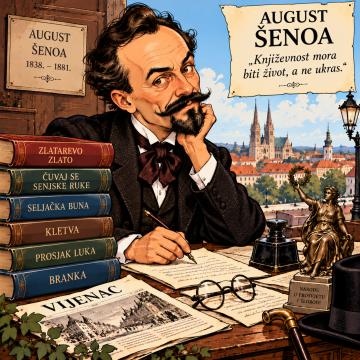
August Šenoa (1838–1881), a Croatian writer, poet, novelist, critic, and editor, was born on November 14, 1838, in Zagreb, where he died on December 13, 1881. He is considered the founder of the modern Croatian novel and one of the most significant writers in 19th-century Croatian literature. The period of his activity is known as the Šenoa Era, marked by the flourishing of realist prose and the strengthening of national literature.
He was educated in Zagreb, Pécs, and Prague, where he studied law and became acquainted with European literary and political ideas. Upon returning to Zagreb, he worked as a journalist, theater critic, dramaturg for the Croatian National Theatre, and city senator. From 1874 until his death, he edited the literary magazine Vienac, which, under his leadership, became the focal point of Croatian literary life.
He gained literary renown with the historical novel Zlatarovo zlato (The Goldsmith's Gold, 1871), which is considered the first Croatian historical novel. In it, he depicts 16th-century Zagreb, weaving a love story together with social conflicts and historical events.
This was followed by the novels Čuvaj se senjske ruke (Beware the Hand of Senj, 1875), Seljačka buna (Peasant Revolt, 1877), and Diogenes (1878), in which he explores the relationship between the individual and history, national identity, social injustice, and the struggle for freedom. His final novel, Kletva (The Curse), remained unfinished.
Notable among his short stories are Prijan Lovro (1873), Prosjak Luka (1879), and Branka (1881)—works that offer realistic portrayals of social relations, poverty, education, and the individual's position in society. He also wrote poems, feuilletons, theater reviews, and literary essays.
Šenoa advocated for literature close to the people—literature capable of simultaneously educating, entertaining, and fostering social progress. His style is characterized by vivid characters, dynamic plots, historical authenticity, and a clear moral message.
Through his novels, short stories, and editorial work, he laid the foundations of Croatian realist literature and profoundly influenced the development of national culture and the reading public.
Titles in our offer
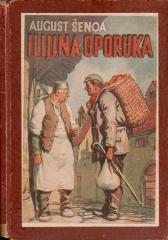
Ilijina oporuka / Lijepa Anka
Book 16 of the Collected Works of August Šenoa combines two powerful narratives: a satirical critique of civic immorality and wastefulness in Ilija's Testament and a romantic, dramatic story of unhappy love and social barriers in Lijepa Anka.
Karamfil sa pjesnikova groba / Pruski kralj / Turci idu / U akvariju
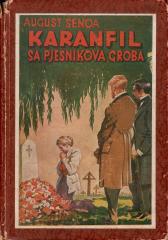
Karanfil sa pjesnikova groba / Pruski kralj / U akvariju
The book 19 Collected Works of August Šenoa brings together three diverse narratives: a romantic-national story about love and Slavicism, a satirical humorous and sharp social criticism of Zagreb's bourgeois society.
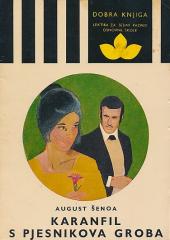
Karanfil s pjesnikova groba i druge pripovijesti
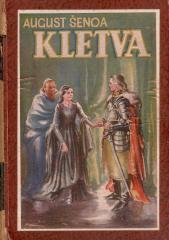
Kletva 2
Book 12 of the Collected Works of August Šenoa is a continuation of the epic historical novel set in the 14th century. The conflicts between Kaptol and Grič escalate, and the consequences of the bishop's curse increasingly determine the fates of the chara