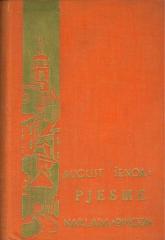
August Šenoa
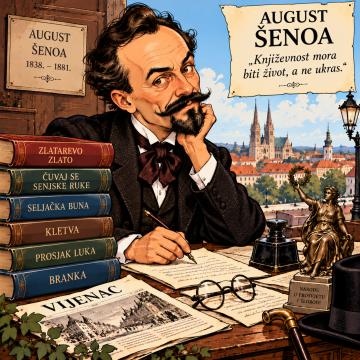
August Šenoa (1838–1881), a Croatian writer, poet, novelist, critic, and editor, was born on November 14, 1838, in Zagreb, where he died on December 13, 1881. He is considered the founder of the modern Croatian novel and one of the most significant writers in 19th-century Croatian literature. The period of his activity is known as the Šenoa Era, marked by the flourishing of realist prose and the strengthening of national literature.
He was educated in Zagreb, Pécs, and Prague, where he studied law and became acquainted with European literary and political ideas. Upon returning to Zagreb, he worked as a journalist, theater critic, dramaturg for the Croatian National Theatre, and city senator. From 1874 until his death, he edited the literary magazine Vienac, which, under his leadership, became the focal point of Croatian literary life.
He gained literary renown with the historical novel Zlatarovo zlato (The Goldsmith's Gold, 1871), which is considered the first Croatian historical novel. In it, he depicts 16th-century Zagreb, weaving a love story together with social conflicts and historical events.
This was followed by the novels Čuvaj se senjske ruke (Beware the Hand of Senj, 1875), Seljačka buna (Peasant Revolt, 1877), and Diogenes (1878), in which he explores the relationship between the individual and history, national identity, social injustice, and the struggle for freedom. His final novel, Kletva (The Curse), remained unfinished.
Notable among his short stories are Prijan Lovro (1873), Prosjak Luka (1879), and Branka (1881)—works that offer realistic portrayals of social relations, poverty, education, and the individual's position in society. He also wrote poems, feuilletons, theater reviews, and literary essays.
Šenoa advocated for literature close to the people—literature capable of simultaneously educating, entertaining, and fostering social progress. His style is characterized by vivid characters, dynamic plots, historical authenticity, and a clear moral message.
Through his novels, short stories, and editorial work, he laid the foundations of Croatian realist literature and profoundly influenced the development of national culture and the reading public.
Titles in our offer
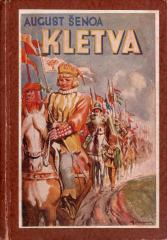
Kletva 3
The Curse 3 (Book 13 of Collected Works) by August Šenoa is a continuation of the epic historical novel about the 14th century, the conflicts between Kaptol and Grič, the revolt of the nobles against King Sigismund, and the fates of the characters under
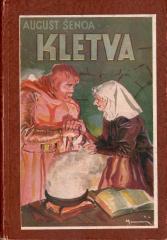
Kletva 4
The Curse 4 (Book 14 of the Collected Works) is the concluding part of the epic historical novel. The conflicts of Kaptol and Grič, the revolt of the nobles against King Sigismund, and the consequences of the bishop's curse culminate in a dramatic denouem
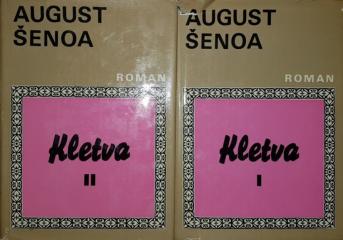
Kletva I-II
La trezoro de l'orajisto
Manja djela: Čudnovita dveh kaputov zmešarija Slavka / Glas od Gradne / Književno pismo / Kapetan Izailo / Mešterski list
The twelfth volume of the Collected Works of August Šenoa – a collection of smaller prose and journalistic works: humorous stories, satire, literary letters and historical sketches from the pen of the most significant Croatian writer of the 19th century.
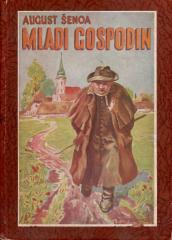
Mladi gospodin
August Šenoe's Young Gentleman, Book 4 of Collected Works, is a humorous story about the experiences of the young chaplain Janko Lugarić in the parishes of Posavina. A popular, illustrated edition with illustrations by Andrija Maurović.
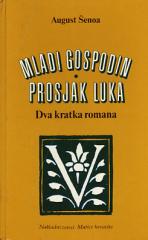
Mladi gospodin / Prosjak Luka
Young gentleman: August Šenoa describes the chaplain Janko Lugarić, whose real name was Janko Puškarić (1801-1874), and he was a chaplain until his death in various parishes in Hrvatski Zagorje, Pokuplje and Turopolje.
Mladi gospodin, Prosjak Luka
Young gentleman: August Šenoa describes the chaplain Janko Lugarić, whose real name was Janko Puškarić (1801-1874), and who served as a chaplain until his death in various parishes in Hrvatsko Zagorje, Pokuplje and Turopolje.
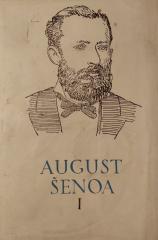
Pet stoljeća hrvatske književnosti #59: August Šenoa I
Volume number 1 from the "Five Centuries of Croatian Literature" series is dedicated to August Šenoa, one of the most important Croatian writers of the 19th century.