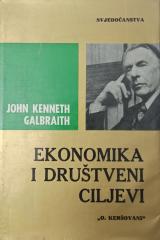
John Kenneth Galbraith

John Kenneth Galbraith (Iona Station, Ontario, 15 October 1908 – Cambridge, Massachusetts, 29 April 2006) was a Canadian-born American economist, professor, diplomat and essayist. One of the twentieth century’s most recognisable economic thinkers, he connected economic analysis with institutions, political influence and everyday life.
Educated in Canada and at the University of California, Berkeley, Galbraith spent much of his academic career at Harvard. During the Second World War he helped administer American price controls and subsequently advised Democratic presidents. He served as United States ambassador to India from 1961 to 1963 under John F. Kennedy.
In American Capitalism (1952), he developed the concept of countervailing power, examining how unions, organised buyers and other institutions could balance corporate influence. The Great Crash 1929 (1955) investigated financial speculation and collapse. His best-known book, ** The Affluent Society (1958)**, contrasted private affluence with neglected public needs and questioned the independence of consumer demand in an economy shaped by advertising.
The New Industrial State (1967) analysed large corporations governed by a “technostructure” of managers and specialists able to influence markets through planning. Later works include Economics and the Public Purpose (1973), The Age of Uncertainty (1977), The Anatomy of Power (1983), A Short History of Financial Euphoria (1990) and The Culture of Contentment (1992).
He also published the memoir A Life in Our Times (1981), the satirical novel A Tenured Professor (1990) and The Economics of Innocent Fraud (2004). Clarity, wit and scepticism towards conventional economic explanations distinguish his writing. An advocate of public investment and social responsibility, he insisted that understanding an economy requires examining how power is distributed and exercised.
Titles in our offer

Doba neizvjesnosti
Galbraith acknowledges the success of the market economy, but at the same time, according to him, this system is characterized by instability, inefficiency and social inequality. This is why he advocates that state interventionism to correct these market

Dobro društvo: Humani plan
In The Good Society: A Humane Plan, distinguished economist John Kenneth Galbraith proposes a radical vision of a more just society that subordinates economic growth to the well-being and dignity of all citizens.

Nova industrijska država
Technocracy Record Book