Robert A. Heinlein
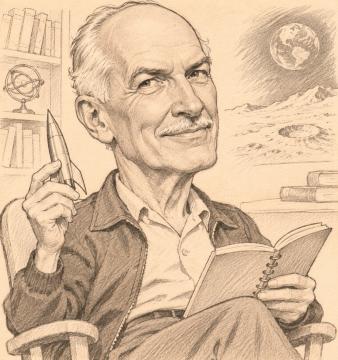
Robert Anson Heinlein (Butler, Missouri, 7 July 1907 – Carmel, California, 8 May 1988) was an American writer and a formative influence on twentieth-century science fiction. Alongside Isaac Asimov and Arthur C. Clarke, he is commonly counted among the genre’s “Big Three”. A graduate of the United States Naval Academy, he served as a naval officer before illness ended his military career.
His first published story, “Life-Line” (1939), appeared in Astounding Science Fiction. He developed the Future History sequence, linking stories and novels within a projected chronology of technological, political and social change. Technical detail and convincing everyday behaviour gave his imagined societies a distinctive sense of reality.
His early career also produced influential novels for younger readers, including Rocket Ship Galileo (1947), Red Planet (1949), Farmer in the Sky (1950) and Have Space Suit—Will Travel (1958). Adventure becomes a framework for learning, independence and responsibility.
Four novels won contemporary Hugo Awards: Double Star (1956), Starship Troopers (1959), Stranger in a Strange Land (1961) and The Moon Is a Harsh Mistress (1966). They examine identity, civic obligation, religion, social convention and resistance to political authority. Stranger in a Strange Land, featuring a human raised on Mars, became particularly influential through its questioning of terrestrial values.
Later works such as Time Enough for Love (1973) expanded his explorations of longevity, sexuality and alternative communities. In 1974, the Science Fiction Writers of America named him its first Grand Master.
Individual liberty, self-reliance and responsibility towards society remain central tensions in his fiction. His political and social proposals provoked debate, while his narrative vitality and range of speculation helped establish the possibilities of modern science fiction.
Titles in our offer

Futura - Znanstvena fantastika & fantasy #20/1994
Časopis Futura bio je hrvatski časopis za spekulativnu fikciju, prvenstveno za znanstvenofantastičnu književnost. Prvi broj Futura izišao je u listopadu 1992. godine.

Metusalemova deca
Kad javnost otkrije dugovječnost obitelji Howard, zavist prerasta u progon. Lazarus Long predvodi bijeg sa Zemlje, a potraga za sigurnim svijetom otvara pitanja slobode, pripadnosti i cijene dugoga života.

Sirius #27: Biblioteka znanstvene fantastike
Sirius war ein kroatisches Science-Fiction-Magazin. Die Gründung wurde 1976 von Damir Mikuličić vorgeschlagen. In Sirius wurden Werke inländischer Autoren sowie Übersetzungen ausländischer Science-Fiction-Autoren veröffentlicht. Es wurde von 1976 bis 1989

Sirius #29: Biblioteka znanstvene fantastike
Sirius war ein kroatisches Science-Fiction-Magazin. Die Gründung wurde 1976 von Damir Mikuličić vorgeschlagen. In Sirius wurden Werke inländischer Autoren sowie Übersetzungen ausländischer Science-Fiction-Autoren veröffentlicht. Es wurde von 1976 bis 1989

Sirius #60: Biblioteka znanstvene fantastike
Sirius war ein kroatisches Science-Fiction-Magazin. Die Gründung wurde 1976 von Damir Mikuličić vorgeschlagen. In Sirius wurden Werke inländischer Autoren sowie Übersetzungen ausländischer Science-Fiction-Autoren veröffentlicht. Es wurde von 1976 bis 1989