Aristotel
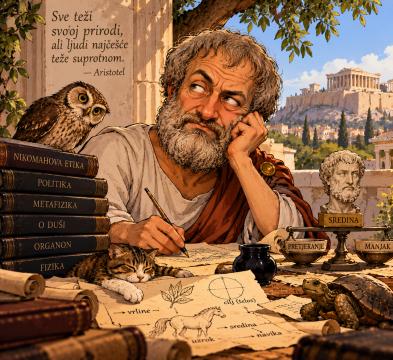
Aristotle (384–322 BC) was a Greek philosopher and scientist, and one of the most influential thinkers in the Western intellectual tradition. He was born in Stagira, in Chalcidice. His father, Nicomachus, was a physician associated with the Macedonian court—a fact that likely contributed to Aristotle’s early interest in nature and empirical inquiry.
Around the age of seventeen, he arrived in Athens and joined Plato’s Academy, where he remained for approximately twenty years. Although he deeply respected Plato, he gradually diverged from Plato’s doctrine of Ideas. While Plato emphasized a transcendent realm of eternal forms, Aristotle sought the starting point of knowledge in the concrete world, in observation, and in the systematic study of reality.
After Plato’s death, he left Athens and, at the invitation of King Philip II of Macedon, became the tutor to the king's son—the future Alexander the Great. Upon returning to Athens, he founded his own philosophical school, the Lyceum (Lykeion). There, he developed an extensive research program encompassing logic, metaphysics, ethics, politics, biology, physics, psychology, rhetoric, and literary theory.
Aristotle’s body of work is vast, even though a significant portion of his original writings has been lost. Notable among his surviving works are Metaphysics, Nicomachean Ethics, Politics, Physics, On the Soul, Rhetoric, and Poetics. His logical writings are traditionally collected under the title Organon, and his works on zoology and natural philosophy are also significant.
In the Nicomachean Ethics, he examines human happiness—or eudaimonia—linking the good life to action in accordance with virtue and reason. In Politics, he studies various forms of government, while Poetics presents one of the most influential analyses of tragedy, mimesis, and catharsis in the history of literary theory.
Aristotle’s thought profoundly shaped ancient, Islamic, and medieval Christian philosophy, particularly the Scholasticism of Thomas Aquinas. His emphasis on logical reasoning, classification, observation, and argumentation left an enduring mark on philosophy and the development of scientific thought.
Titles in our offer
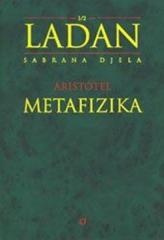
Metafizika
Metaphysics is Aristotle's most famous and influential philosophical work, consisting of 14 books. The name Metaphysics is not Aristotle's – it came later because the writings were placed "behind physics" (meta ta physika).