Charles de Montesquieu
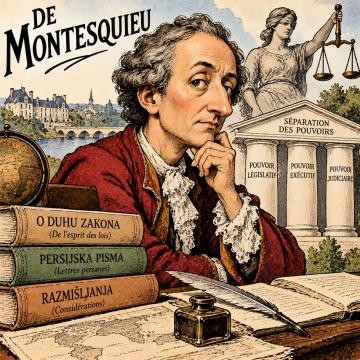
Charles-Louis de Secondat, Baron de La Brède and de Montesquieu (La Brède, January 18, 1689 – Paris, February 10, 1755) was a French philosopher, writer, jurist, and political thinker, and one of the most significant figures of the Enlightenment. He came from a noble family, studied law, and served as president of the judicial chamber in Bordeaux. His interest in law, history, and social institutions shaped a philosophical outlook that profoundly influenced the development of modern democracy.
He achieved literary fame with the satirical epistolary novel Persian Letters (Lettres persanes, 1721), in which, through the eyes of two Persian travelers, he wittily critiques French society, absolutism, religious intolerance, and social customs. The work is considered one of the most important literary achievements of the French Enlightenment.
After years of traveling across Europe—particularly England—he published the historical-political treatise Considerations on the Causes of the Grandeur and Decadence of the Romans (1734), in which he examines the principles governing the rise and fall of states. His most significant work, The Spirit of the Laws (De l’esprit des lois, 1748), forms the foundation of modern political philosophy and constitutional law. In that work, he developed the famous theory of the separation of powers into legislative, executive, and judicial branches, emphasizing that citizens' liberty can endure only if the different branches of government check one another. He also studied the influence of climate, geography, the economy, customs, and historical circumstances on the shaping of laws and political systems.
Montesquieu advocated for political moderation, religious tolerance, civil liberties, and the limitation of arbitrary power. In 1728, he was elected to the French Academy, and his body of work became an important part of the European intellectual heritage.
He died in Paris in 1755. His ideas strongly influenced the American Constitution, the French Revolution, and the development of modern democratic institutions. Montesquieu remains one of the key thinkers regarding political liberty, constitutionalism, and the rule of law.
Titles in our offer
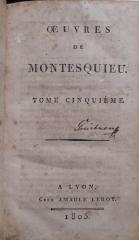
Oeuvres de Montesquieu - tome cinquieme: Lettres Persanes
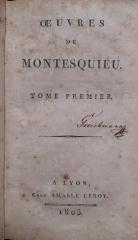
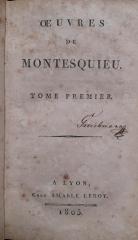
Oeuvres de Montesquieu - tome premier: Esprit des Loix
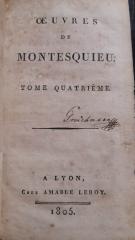
Oeuvres de Montesquieu - tome quatrieme: Esprit des Loix
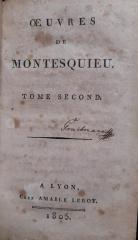
Oeuvres de Montesquieu - tome second: Esprit des Loix

Oeuvres de Montesquieu - tome septieme: Lettres familieres
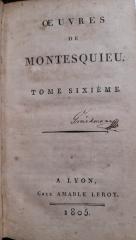
Oeuvres de Montesquieu - tome sixieme: Grandeur des Romains