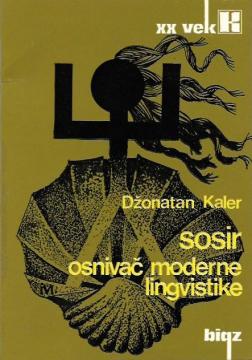
Sosir - osnivač moderne lingvistike
Jonathan Culler, an American literary and structuralist theorist, presents Ferdinand de Saussure in this classic study as the father of modern linguistics – a thinker who, along with Freud and Durkheim, revolutionized the study of man and society.
Saussure did not publish any major works during his lifetime; his influence comes from his posthumously compiled Course in General Linguistics (Cours de linguistique générale, 1916), student notes from lectures in Geneva from 1907–1911. Culler explains how this work became the foundation of structuralism, semiotics, and later theories (Barthes, Lévi-Strauss, Lacan, Derrida).
Key contributions that Culler highlights:
- Language as a system of signs: Sign = signifier (sound/form) + signified (concept). The relationship is arbitrary (conventional, not natural), except in onomatopoeia.
- Langue vs. parole: Langue is an abstract, collective system of rules in the speaker's brain (social code); parole is an individual realization in speech/writing.
- Synchrony vs. dichrony: Synchronic linguistics studies language as a system at a single moment (structure); dichrony – historical changes. Saussure gives priority to synchrony, reversing the previous historical philology.
- Difference and value: Meaning is not inherent, but arises from differences within the system (negative opposition). Language is a system of differential values - without positive terms.
- Semiology: Saussure proposes a general science of signs in society (anticipating semiotics).
Culler emphasizes Saussure's influence on modern thought: language is not just communication, but the way we construct reality. His ideas enabled structuralism, poststructuralism and interdisciplinary approaches (anthropology, psychoanalysis, literary theory).
This little book – clear, concise and accessible – is an ideal introduction to Saussure and structuralism. Today an antiquarian rarity (BIGZ edition in demand among theory students), perfect for those who want to understand the roots of modern linguistics and sign theory.
One copy is available