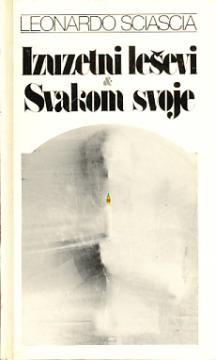
Izuzetni leševi / Svakom svoje

Izuzetni leševi / Svakom svoje

Leonardo Sciascia

Extraordinary Corpses and Each to His Own are two of the most famous political-crime novels by Leonardo Sciascia, an Italian writer and essayist who, through literature, dissected the mechanisms of power, corruption, and evil in contemporary society, espe

Both novels explore the deep-rooted relationships between the mafia, the judiciary, politics and ordinary people, with an emphasis on the moral and existential crisis of the individual in a world where justice is becoming increasingly abstract.

In "To Each His Own", the plot begins with the murder of a village pharmacist, which seems personal, but gradually reveals a network of political, mafia and social interests. The main character, Professor Laurana, tries to use logic and intellect to expose the crime, but his search for the truth ends tragically - which speaks of the powerlessness of the individual in the face of a system of silence and fear.

"Exceptional Corpses" depicts a series of political assassinations of high-ranking judicial officials, which raises the question: has the law become a means of power, not justice? The investigator in the novel gradually realizes that he is trapped in a situation where no one is interested in the truth - neither the system nor the public. The novel acts as an allegory of authoritarianism, showing how democracy can also turn into a repressive mechanism.

Sciascia writes precisely, ironically and intellectually deeply. His characters are not classic heroes – they are moral seekers in a world without landmarks. These novels, although styled as crime stories, are actually philosophical and political reflections on truth, power and responsibility.

Original title
Il contesto, una parodia / A ciascuno il suo
Translation
Tonko Maroević
Editor
Nenad Popović
Graphics design
Zoran Pavlović
Dimensions
19.5 x 12 cm
Pages
228
Publisher
Grafički zavod Hrvatske (GZH), Zagreb, 1981.
 
Latin alphabet. Hardcover.
Language: Croatian.

Two copies are available

Copy number 1

Condition:Used, excellent condition

Copy number 2

Condition:Used, excellent condition
 

Are you interested in another book? You can search the offer using our search engine or browse books by category.

You may also be interested in these titles

Rudnik čvaraka

Rudnik čvaraka

Tomislav Šovagović

The debut work of Croatian writer Tomislav Šovagović, awarded the Josip and Ivan Kozarac Award in 2012, is a dedication to Slavonia – the region of his childhood that the author, born in Dalmatia, observes with foreign but tender eyes.

Mozaik knjiga, 20112.
Croatian. Latin alphabet. Paperback.
11.569.25
Kreutzerova sonata, Hadži-Murat

Kreutzerova sonata, Hadži-Murat

Lav Nikolajevič Tolstoj

Kreutzer's sonata belongs to those works of Tolstoy that the writer adapted in many ways to his view on moral issues, on marital morality above all.

Civitas, 2004.
Croatian. Latin alphabet. Paperback.
4.983.98
Magična ljubavna kutijica

Magična ljubavna kutijica

Santa Montefiore

The Magic Love Box (2002) follows the life story of Federica Campione, which begins in Vina del Mar, Chile, in the summer of 1982. Montefiore creates an epic story of growth, where the magic is not only in the box, but in the courage to let go of the past

Mozaik knjiga, 2006.
Croatian. Latin alphabet. Hardcover.
7.34
Shannonov put

Shannonov put

Archibald Joseph Cronin

Cronin's moving story of redemption. Robert Shannon, a fanatical doctor-researcher, sacrifices love and life for science, but in the end loses everything – his girlfriend, recognition, health – only to realize through suffering: medicine without humanity

Otokar Keršovani, 1966.
Croatian. Latin alphabet. Hardcover with dust jacket.
6.244.37
Made in U.S.A.

Made in U.S.A.

Goran Tribuson

Imagine Zagreb in the 1980s, where behind the gray facades of apartment buildings lies a dream world of the far West – Hollywood, freedom and endless possibilities. Tribuson, a master of Croatian prose, here combines genres into one fluid story that bites

Znanje, 1986.
Croatian. Latin alphabet. Hardcover with dust jacket.
5.72
Proces

Proces

Franz Kafka

Kafka wrote The Process between 1914 and 1915, published posthumously in 1925. The novel is unfinished but with an added final chapter by Max Brod. Edition with a foreword by B. Živojinović and an afterword by Walter Killi.

BIGZ, 1990.
Serbian. Latin alphabet. Paperback.
4.26