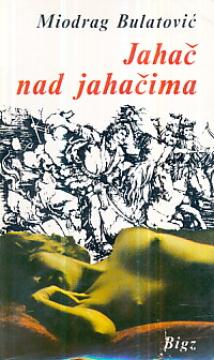
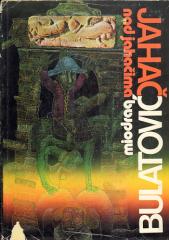
Jahač nad jahačima

Jahač nad jahačima

Miodrag Bulatović

A novel about the absurd, power and downfall of a man obsessed with greatness. In a symbolic, grotesque world, the author exposes the cruelty of power and madness in which ambition and fear blur the line between man and beast.

The novel The Rider of Riders (published in 1966) is one of the most significant and complex works by Miodrag Bulatović, a writer known for his grotesque expression and exploration of the dark depths of the human psyche. The work is an allegory of violence, deformed morality, and the spread of madness in societies that idolize power.

The action takes place in a closed, symbolic space resembling a totalitarian world in which the "rider" appears — a figure of power, obsessed with his own greatness and superiority over others. His rise and fall are depicted through the prism of fantastic and grotesque scenes, in which reality loses its shape, and the line between oppressor and victim disappears.

Bulatović uses strong metaphors, dense language, and a mixture of black humor, irony, and brutal realism to depict the dehumanization and destructiveness of power, but also man's inner need for submission and domination. The novel is imbued with an atmosphere of anxiety, visions and madness, which makes it close to the tradition of Dostoyevsky and Kafka, although it retains southern, Balkan poetics.

At the center of Riders over Riders is not only the dictator, but also the mass that supports him and feeds his power — Bulatović thereby opens up the question of responsibility, collective fear and moral failure. Due to its symbolism, aesthetic power and universal themes, the novel is counted among the masterpieces of modernist and existential prose of former Yugoslavian literature.

Graphics design
Rade Rančić
Dimensions
18 x 10.5 cm
Pages
216
Publisher
BIGZ, Beograd, 1983.
 
Distribution: 20,000 copies
 
Latin alphabet. Paperback.
Language: Serbian.

No copies available

The last copy was sold recently.
 

Are you interested in another book? You can search the offer using our search engine or browse books by category.

You may also be interested in these titles

Jahač nad jahačima

Jahač nad jahačima

Miodrag Bulatović

A novel about the absurd, power and downfall of a man obsessed with greatness. In a symbolic, grotesque world, the author exposes the cruelty of power and madness in which ambition and fear blur the line between man and beast.

Partizanska knjiga, 1980.
Serbian. Latin alphabet. Hardcover with dust jacket.
9.998.99
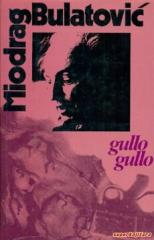
Gullo Gullo

Gullo Gullo

Miodrag Bulatović

Gullo Gullo is a grotesquely powerful novel about the moral and spiritual decay of a human being. In a world of violence, fear and absurdity, the main character wanders between life and death, good and evil, in search of meaning in a tragically twisted re

Prosveta, 1983.
Serbian. Latin alphabet. Hardcover with dust jacket.
2.82
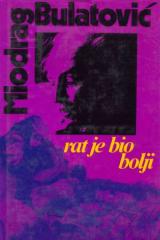
Rat je bio bolji

Rat je bio bolji

Miodrag Bulatović

Conceived and realized as a separate entity, this novel can also be interpreted as the second part of the book "The Hero on the Donkey." To a greater extent than in "The Hero," here the war "which was better" is depicted as a gigantic burlesque and a pool

Prosveta, 1983.
Serbian. Latin alphabet. Hardcover with dust jacket.
2.99
Stotina godina (antikronika)

Stotina godina (antikronika)

Dario Harjaček

The novel One Hundred Years by Dario Harjaček provides a panoramic view of Trešnjevka and its inhabitants through a century of changes, ideologies, and human destinies – a mosaic of Zagreb in which life, art, and history intertwine.

Oceanmore, 2025.
Croatian. Latin alphabet. Paperback.
13.42
Pariški maraton : Knjiga pisanja (Pariz21. i 22. oktobar 2023)

Pariški maraton : Knjiga pisanja (Pariz21. i 22. oktobar 2023)

At the end of the eighties, Damir Uzunović traveled to Paris and stayed there for less than a year. He was twenty years old at the time, and that exile episode would be formative for the literature he would later write.

Buybook, 2024.
Croatian. Latin alphabet. Hardcover.
12.22
Usta puna zemlje

Usta puna zemlje

Branimir Šćepanović

The novel "Usta puna zemlje" (1970), the masterpiece of the Serbian writer Branimir Šćepanović, is a psychologically in-depth explorer of the limits of the human soul, solitude and existential freedom, reminiscent of Kafka and Camus.

BIGZ, 1987.
Serbian. Latin alphabet. Paperback.
3.98