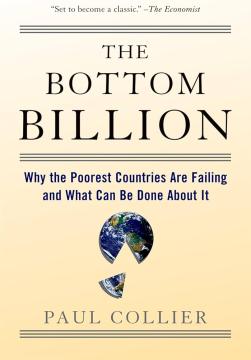
The Bottom Billion: Why the Poorest Countries are Failing and What Can Be Done About It

The Bottom Billion: Why the Poorest Countries are Failing and What Can Be Done About It

Paul Collier

In the universally acclaimed and award-winning The Bottom Billion, Paul Collier reveals that fifty failed states--home to the poorest one billion people on Earth--pose the central challenge of the developing world in the twenty-first century.

The book shines much-needed light on this group of small nations, largely unnoticed by the industrialized West, that are dropping further and further behind the majority of the world's people, often falling into an absolute decline in living standards. A struggle rages within each of these nations between reformers and corrupt leaders and the corrupt are winning. Collier analyzes the causes of failure, pointing to a set of traps that ensnare these countries, including civil war, a dependence on the extraction and export of natural resources, and bad governance.

Dimensions
21 x 14 cm
Pages
209
Publisher
Oxford University Press, Oxford, 2008.
 
Latin alphabet. Paperback.
Language: English.

One copy is available

Condition:Unused
 

Are you interested in another book? You can search the offer using our search engine or browse books by category.

You may also be interested in these titles

Teološka bilježnica - Svijet kroz teološke oči

Teološka bilježnica - Svijet kroz teološke oči

Ivica Šola

The book is a comprehensive publicistic work in the form of essays in which social, religious, political and media phenomena are read in the manner of theological hermeneutics, through the prism of a theological eye. It is composed of five chapters.

Osječki list, 2006.
Croatian. Latin alphabet. Paperback.
13.56
Jedna planeta je opljačkana : zastrašujući bilans jedne politike

Jedna planeta je opljačkana : zastrašujući bilans jedne politike

Herbert Grul

The book was published in September 1975 by the then CDU representative in the Bundestag, Herbert Gruhl. After the Club of Rome showed the "limits to growth" on our planet, Gruhl raised the question in this book about the remaining possibilities of our ec

Prosveta, 1985.
Serbian. Latin alphabet. Paperback.
5.98 - 5.99
U ime naroda! Sudski proces profesorima i bogoslovima đakovačkog sjemeništa 1959./1960.

U ime naroda! Sudski proces profesorima i bogoslovima đakovačkog sjemeništa 1959./1960.

Stjepan Sršan
Državni arhiv u Osijeku, 2009.
Croatian. Latin alphabet. Paperback.
17.32
Pablo Picasso (Majstori 20. stoljeća)

Pablo Picasso (Majstori 20. stoljeća)

Hans L. Jaffe

Pablo Picasso (Malaga, October 25, 1881 - Mougins, April 8, 1973) was a Spanish painter, co-founder of Cubism and one of the most famous artists of the 20th century.

Naprijed, 1970.
Croatian. Latin alphabet. Paperback.
9.36 - 10.39
National Geographic Hrvatska #5: Alergije - Pošast suvremenog svijeta

National Geographic Hrvatska #5: Alergije - Pošast suvremenog svijeta

Adria media, 2006.
Croatian. Latin alphabet. Paperback.
2.00
I drugi su pjevali o ratu: Odjeci raspada Jugoslavije u engleskoj i američkoj književnosti

I drugi su pjevali o ratu: Odjeci raspada Jugoslavije u engleskoj i američkoj književnosti

Muharem Bazdulj

In this book of essays, Muharem Bazdulj analyzes how the collapse of Yugoslavia and the wars of the 1990s resonated in Anglo-Saxon literature – from pre-war stereotypes to war and post-war depictions.

Biblioteka XX vek, 2013.
Croatian. Latin alphabet. Paperback.
8.24