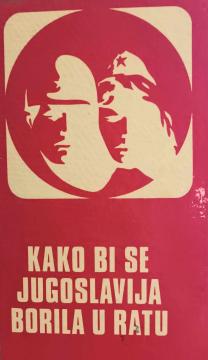
Kako bi se Jugoslavija borila u ratu

Kako bi se Jugoslavija borila u ratu

Luka Despenjić

How Yugoslavia would fight in the war, brings an interesting insight into the military strategies and tactics of that time.

If you are interested in learning more about how military strategists and soldiers prepared for potential conflicts, this book may provide some interesting insight.

Editor
Mensur Seferović
Graphics design
Aleksandar Švedić
Dimensions
20.5 x 12.5 cm
Pages
189
Publisher
Narodna armija, Beograd, 1973.
 
Distribution: 10,000 copies
 
Latin alphabet. Hardcover.
Language: Croatian.

One copy is available

Condition:Used, excellent condition
Damages or inconvenience notice:
  • Library stamp
 

Are you interested in another book? You can search the offer using our search engine or browse books by category.

You may also be interested in these titles

I drugi su pjevali o ratu: Odjeci raspada Jugoslavije u engleskoj i američkoj književnosti

I drugi su pjevali o ratu: Odjeci raspada Jugoslavije u engleskoj i američkoj književnosti

Muharem Bazdulj

In this book of essays, Muharem Bazdulj analyzes how the collapse of Yugoslavia and the wars of the 1990s resonated in Anglo-Saxon literature – from pre-war stereotypes to war and post-war depictions.

Biblioteka XX vek, 2013.
Croatian. Latin alphabet. Paperback.
8.24
Nacionalno pitanje

Nacionalno pitanje

Omladinski otsek Polit, 1946.
Serbian. Latin alphabet. Paperback.
28.96
Doživljaji i putovanja do slobode

Doživljaji i putovanja do slobode

Vladimir Novak

The autobiographical work of Croatian communist activist Vladimir Novak, a survivor of the Ustasha camps, follows his memories of resistance to fascism during World War II.

August Cesarec, 1979.
Croatian. Latin alphabet. Hardcover with dust jacket.
8.26
Zaraćeno poraće: Konfliktni i konkurentski narativi o stradanju i iseljavanju Talijana Istre

Zaraćeno poraće: Konfliktni i konkurentski narativi o stradanju i iseljavanju Talijana Istre

Franko Dota

The book analyzes how conflicting historical narratives about the suffering and mass emigration of Italians from Istria and Rijeka developed in Croatia and Italy after World War II (1943–1956), debunking myths and encouraging an empathetic approach to the

Srednja Europa, 2010.
Croatian. Latin alphabet. Paperback.
11.328.49
Tito građanin sveta

Tito građanin sveta

Zvonko Štaubringer

The book contains forewords by Indira Gandhi and Mitja Ribicic, and deals with Tito's humanistic vision, his efforts for peace, the challenges he faced, and his wisdom as a statesman.

Radnička štampa, 1974.
Serbian. Latin alphabet. Hardcover with dust jacket.
5.82
Živojin Pavlović: Između dogme i kritike

Živojin Pavlović: Između dogme i kritike

Slobodan Gavrilović

In terms of the number and content of facts, systematics, and method of interpretation, Gavrilović's work surpasses ordinary historiographical reading and stands side by side with the best literary creations about the events of one time and their actors.

Grafocard, 2001.
Serbian. Cyrillic alphabet. Paperback.
9.58