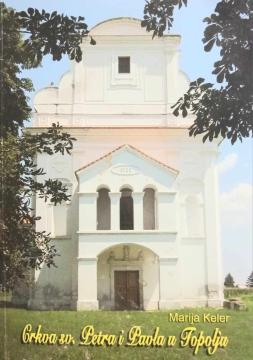
Crkva sv. Petra i Pavla u Topolju

Crkva sv. Petra i Pavla u Topolju

Marija Keler

Church of St. Peter and Paul in Topolje, which is located outside the settlement, a kilometer away from Topolje on the road to Draž, has an interesting and somewhat creepy history.

Here are some facts about this church:

Year of construction: The first church in Baranja was built in 172212. The most interesting fact: During construction, its tower collapsed three times! The builders tried in vain to build the tower and the cross, but it is strange that lightning struck the cross of the church of St. Peter and Paul. After these unusual events, the builders gave up further attempts. Mysterious stories and legends: The church is located on a Turkish cemetery, where a great battle took place in 1687 in which many Ottomans lost their lives. Because of this, it is rumored that this is precisely the reason that the belfry never survived. Also, there are rumors that whoever tried to forcefully enter the church or desecrated it, did not fare well or even paid with his head. Architectural importance: Church of St. Peter and Paul is a cultural monument of the 1st category and is counted among the most important baroque sacral buildings in Croatia. Although this church is shrouded in mystery and legends, its architecture and history make it special and worthy of attention.

Translation
Snjezana Bobić, Janos Andoci, Ana Kovačevic, Vlatka Ivić
Editor
Damir Doležal
Illustrations
Damir Doležal, Marija Keler, Adam Tigandžin, Marija i Marko Topalov
Dimensions
21 x 15 cm
Pages
181
Publisher
Matica hrvatska, Beli Manastir, 2011.
 
Latin alphabet. Paperback.
Language: Croatian.
ISBN
978-9-53559-861-9

No copies available

The last copy was sold recently.
 

Are you interested in another book? You can search the offer using our search engine or browse books by category.

You may also be interested in these titles

Povijest i kultura Hrvata kroz 1000 godina: gospodarski i društveni razvitak u 18. i 19. stoljeću

Povijest i kultura Hrvata kroz 1000 godina: gospodarski i društveni razvitak u 18. i 19. stoljeću

Horvat
Josip Horvat

This part of Horvat's work depicts the great changes that affected Croatian lands during the 18th and 19th centuries, a period of transition from feudal to modern society.

Knjigotisak d. o. o., 2009.
Croatian. Latin alphabet. Hardcover.
12.22 - 12.24
Stanje redodržave Bosne Srebrene

Stanje redodržave Bosne Srebrene

Fra Martin Nedić

A historical overview of the organization, activities and crises of the Order of the State of Silver Bosnia throughout the 18th and 19th centuries, with an emphasis on the role of the Franciscans in the social, cultural and political life of Bosnia. Repri

Fortuna d.o.o., 2011.
Croatian. Latin alphabet. Hardcover.
8.62
U modi: Kultura odijevanja porečkih plemenitih građana (1650.-1720.)

U modi: Kultura odijevanja porečkih plemenitih građana (1650.-1720.)

Elena Uljančić

The book represents a novelty not only in Istrian, but also in Croatian historiography. Namely, the clothing culture in the region of Istria in the early modern period has not yet been analyzed at all, and for the region of Dalmatia only sporadically.

Srednja Europa, 2019.
Croatian. Latin alphabet. Hardcover.
16.9913.59
Zakon Vinodolski: Uvod, tekst i tumač

Zakon Vinodolski: Uvod, tekst i tumač

Rudolf Strohal

The antiquarian edition of "Zakon Vinodolski" edited by Rudolf Strohal in 1912, originally published in the "Monthly of the Legal Society", represents one of the most important Croatian philological-legal editions from the beginning of the 20th century.

St. Kugli, 1912.
Croatian. Latin alphabet. Paperback.
22.36
Iznevjereni grad: Dubrovnik 1991

Iznevjereni grad: Dubrovnik 1991

Petar Kriste

A memoir by Petar Krista, a member of the Dubrovnik Crisis Staff, about the first months of the siege of the city. The work records the political background, military reality, and personal drama of the defense of Dubrovnik.

Golden marketing, 2000.
Croatian. Latin alphabet. Hardcover.
18.56
Hrvatske pravice

Hrvatske pravice

Petar Požar

"Croatian Rights" presents a selection of key historical documents that shape the Croatian legal tradition – from medieval charters to modern acts – emphasizing the continuity of Croatian autonomy within the broader European framework.

Vlastita naklada, 1990.
Croatian. Latin alphabet. Hardcover.
5.31