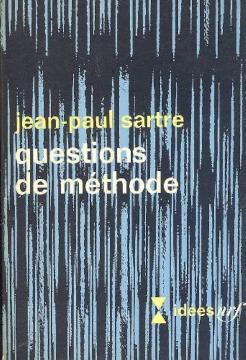
Questions de méthode
Rare book

Questions de méthode

Jean-Paul Sartre

Without calling into question Marx's theses, particularly on the importance of material conditions in human relationships, Sartre intends to show that these relationships, however reified they may be, cannot be dissolved into economics.

To push back the Marxist limit to an understanding of concrete man, of concrete History, he proposes a dialectical, progressive-regressive method, certain notions of which come from existentialism. It is this method that he will implement the following year in his great work (which he calls here his "second part") Critique of Dialectical Reason.

Dimensions
16.5 x 11 cm
Pages
256
Publisher
Éditions Gallimard, Pariz, 1960.
 
Latin alphabet. Paperback.
Language: French.

No copies available

The last copy was sold recently.
 

Are you interested in another book? You can search the offer using our search engine or browse books by category.

You may also be interested in these titles

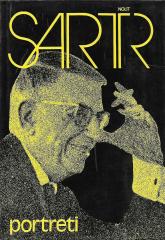
Portreti

Portreti

Jean-Paul Sartre
Nolit, 1981.
Croatian. Latin alphabet. Hardcover with dust jacket.
8.74
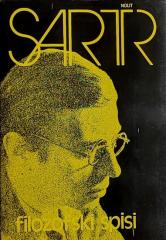
Filozofski spisi

Filozofski spisi

Jean-Paul Sartre
Nolit, 1981.
Serbian. Latin alphabet. Hardcover with dust jacket.
8.56
Utopija

Utopija

Thomas More

In Utopia, Thomas More depicts an imaginary perfect society located on an isolated island, where the ruling principles of harmony, equality and reason overcome the imperfections of European society at the time.

Kultura, 1964.
Serbian. Latin alphabet. Paperback.
6.34
Rasprave o metodi

Rasprave o metodi

Ivan Kuvačić

"Discourses on Method" is a collection of essays and discussions by the prominent Croatian sociologist Ivan Kuvačić (1924–2005), written during his many years of work at the Department of Sociology at the Faculty of Philosophy in Zagreb.

Naprijed, 1988.
Croatian. Latin alphabet. Paperback.
6.74
Politički liberalizam

Politički liberalizam

John Rawls

John Rawls, the founder of modern liberalism, offers a roadmap for a stable society: "Political Liberalism," a sequel to the classic "A Theory of Justice," is not just a philosophical treatise, but a practical model for pluralistic societies like ours.

Kruzak, 2000.
Croatian. Latin alphabet. Paperback.
32.56