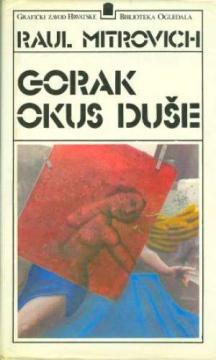
Gorak okus duše

Gorak okus duše

Raul Mitrovich, Feđa Šehović

The novel The bitter taste of the soul by Raul Mitrovich, pseudonym Feđa Šehović, was published in 1983. The work belongs to the type of Croatian new historical novel, where the historical context is present, but is not at the center of the writer's inter

The plot is set in the first half of the 16th century, a period marked by the penetration of the Ottomans into Europe. Dubrovnik, through a skillful diplomatic game with the Turks, manages to maintain its independence, which becomes a key element in the development of the story.

The main character, Friar Vincenc, naively believes in the justice of the Pope and the Christian authorities, which leads him to conflict with Dubrovnik politics and, in the end, to personal tragedy and falling into slavery. Through his fate, the author explores the themes of ideals, betrayal and moral dilemmas. Historical figures such as the historian Ludovik Crijević Tuberon and the poet Ivan Gučetić (Gozza) also appear in the novel, which further enriches the historical context of the work.

Šehović uses postmodernist literary techniques, such as "found manuscripts" and fictitious chronicles, creating a work that is both a historical novel and an allegory for contemporary events. With this approach, the author ranks among the founders of the new historical novel in Croatian literature. The Bitter Taste of the Soul offers an in-depth analysis of human nature and historical circumstances, providing the reader with an insight into the complexity of moral decisions and the consequences they carry.

Editor
Nenad Popović
Graphics design
Zoran Pavlović
Dimensions
19.5 x 12 cm
Pages
132
Publisher
Grafički zavod Hrvatske (GZH), Zagreb, 1983.
 
Latin alphabet. Hardcover with dust jacket.
Language: Croatian.

Two copies are available

Copy number 1

Condition:Used, excellent condition

Copy number 2

Condition:Used, very good condition
Damages or inconvenience notice:
  • Library stamp
  • Slight damage to the dust jacket
 

Are you interested in another book? You can search the offer using our search engine or browse books by category.

You may also be interested in these titles

Prkosna nasljednica

Prkosna nasljednica

Courtney Milan

The author weaves a love story based on the events of the fight for the right to vote in 1867, in which only part of the male population of Britain received the right to vote.

Neptun, 2016.
Croatian. Latin alphabet. Paperback.
10.34
Prvi čovjek Rima III - Put pobjede

Prvi čovjek Rima III - Put pobjede

Colleen McCullough

With exceptional narrative power, Coleen McCullough, one of today's most widely read writers, draws the reader into the vortex of chivalry, passion and opulence, which is called ancient Rome.

Znanje, 2013.
Croatian. Latin alphabet. Paperback.
3.74 - 4.26
Jedna Mađarska jesen

Jedna Mađarska jesen

Ivan Ivanji

This is a novel with autobiographical elements, in which the author, through the character of a writer in his more mature years, reflects on his own life, history, identity, and the political reality of Hungary at the time.

Književna zajednica Novog Sada, 1986.
Serbian. Latin alphabet. Paperback.
5.32
Kraljevstvo snova

Kraljevstvo snova

Judith McNaught

"The Kingdom of Dreams" by Judith McNaught, the first novel in the Westmoreland series, is a classic historical romance set in 1497 on the Anglo-Scottish border in the midst of wars.

Mozaik knjiga, 2012.
Croatian. Latin alphabet. Paperback.
9.64
Knjiga o Jovi Čarugi i Joci Udmaniću

Knjiga o Jovi Čarugi i Joci Udmaniću

Marino Zurl

A famous work by publicist Marin Zurlo that explores the lives of two legendary hajduks – Jovo Stanisavljević Čaruga and Joco Udmanić – who rampaged through Slavonia and Dalmatia in the 1920s, becoming symbols of resistance against injustice.

August Cesarec, 1972.
Croatian. Latin alphabet. Paperback.
7.82
Seljačka buna

Seljačka buna

August Šenoa

August Šenoa's historical novel, which was published in Vijenec in 1877, and was published as a book in 1878. The novel is subtitled "Historical Narrative XVI. century" so it can be seen as a historical monograph in the form of a novel.

Spektar, 1974.
Croatian. Latin alphabet. Hardcover.
6.58