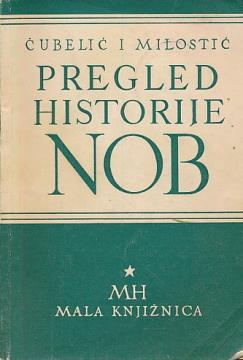
Pregled historije NOB / Pregled narodnooslobodilačkog rata i revolucije naroda Jugoslavije

Pregled historije NOB / Pregled narodnooslobodilačkog rata i revolucije naroda Jugoslavije

Tomo Čubelić, Milovan Milostić

This book provides a deeper insight into the history of the NOB and contributes to the understanding of that key period in Yugoslav history.

Here are some key topics that can be found in this book:

  • The fight against the occupiers: The book describes in detail the resistance of the partisans and the people against the Nazi occupation and fascist regimes during the Second World War. It shows the battles, guerrilla actions and strategies used by NOB fighters.
  • Organization and leadership: The authors analyze the organizational structure and leadership of the partisan movement. This includes the role of Josip Broz Tito and other key leaders in leading the struggle.
  • Social aspects: The book explores how NOB influenced society. These include changes in relationships between people, women's emancipation, the struggle for minority rights and social justice.
  • Ideology and values: The authors analyze the ideology of the communist movement and the values that guided it. These include solidarity, equality, anti-fascism and the struggle for freedom.
  • International context: The book also discusses the international context of the NOB, including cooperation with the Allies, the relationship with the Soviet Union and the role of Yugoslavia in the anti-fascist coalition.

Editor
Nikola Pavić
Dimensions
18.5 x 13 cm
Pages
255
Publisher
Matica hrvatska, Zagreb, 1961.
 
Latin alphabet. Paperback.
Language: Croatian.

No copies available

The last copy was sold recently.
 

Are you interested in another book? You can search the offer using our search engine or browse books by category.

You may also be interested in these titles

Dobri ljudi u vremenu zla

Dobri ljudi u vremenu zla

Svetlana Broz

The book Good people in the time of evil (1999) by Svetlana Broz is a collection of true stories from the war in Bosnia and Herzegovina (1992-1995), which bear witness to the humanity, solidarity and moral courage of individuals in the midst of conflict.

Media centar "Prelom", 2001.
Croatian. Latin alphabet. Paperback.
12.36
I drugi su pjevali o ratu: Odjeci raspada Jugoslavije u engleskoj i američkoj književnosti

I drugi su pjevali o ratu: Odjeci raspada Jugoslavije u engleskoj i američkoj književnosti

Muharem Bazdulj

In this book of essays, Muharem Bazdulj analyzes how the collapse of Yugoslavia and the wars of the 1990s resonated in Anglo-Saxon literature – from pre-war stereotypes to war and post-war depictions.

Biblioteka XX vek, 2013.
Croatian. Latin alphabet. Paperback.
8.24
Sudbonosni podvig Jugoslavije: Podsjećanje na historijsko NE staljinizmu, događaj koji je opredijelio budućnost Jugoslavije

Sudbonosni podvig Jugoslavije: Podsjećanje na historijsko NE staljinizmu, događaj koji je opredijelio budućnost Jugoslavije

Raif Dizdarević

The book by Raif Dizdarević, one of the last living actors of Yugoslav diplomacy, presents his reconstruction of the most fateful moment of post-war Yugoslavia – the split with Stalin and the Informburo in 1948–1953.

Udruženje za modernu historiju (UMHIS), 2018.
Croatian. Latin alphabet. Paperback.
23.58
Knjiga o Srebrenici – spomenar jednog grada

Knjiga o Srebrenici – spomenar jednog grada

Sadik Salimović

Sadik Salimović's Book of Srebrenica (2002) is a memoir of the city: from Ottoman settlement, Islamization and development to the war suffering of 1992–1995 and genocide. It preserves the identity and memory of life before and after the tragedy.

Skupština opštine Srebrenica, 2002.
Croatian. Latin alphabet. Paperback.
11.32
Zaraćeno poraće: Konfliktni i konkurentski narativi o stradanju i iseljavanju Talijana Istre

Zaraćeno poraće: Konfliktni i konkurentski narativi o stradanju i iseljavanju Talijana Istre

Franko Dota

The book analyzes how conflicting historical narratives about the suffering and mass emigration of Italians from Istria and Rijeka developed in Croatia and Italy after World War II (1943–1956), debunking myths and encouraging an empathetic approach to the

Srednja Europa, 2010.
Croatian. Latin alphabet. Paperback.
11.32
Sam protiv njih

Sam protiv njih

Roman Leljak

A non-fiction work by a Slovenian investigator of the UDB archives. The author, a former KOS employee, left the army after learning about the crimes of the Yugoslav army during the war and the post-war period, and dedicated himself to exposing the secret

Vlastita naklada, 1990.
Croatian. Latin alphabet. Paperback.
16.42