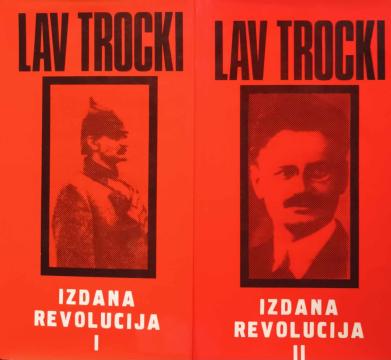
Izdana revolucija

Izdana revolucija

Lav Trocki

"The Betrayed Revolution" (1936) is a key work by Trotsky in which he criticizes the Stalinist regime, arguing that the October Revolution was betrayed due to the bureaucratic distortion of socialist ideals, while calling for the restoration of workers' d

Trotsky, the exiled leader of the revolution, analyzes how Stalin's government took control of the country, turning it into an authoritarian system that stifles workers' democracy.

The book begins with a historical overview of the revolution of 1917 and its goals - the abolition of class differences and the creation of an egalitarian society. Trotsky claims that the Soviet bureaucracy, led by Stalin, has become a new privileged class that exploits workers and peasants. He criticizes economic policies, including forced collectivization and five-year plans, which he says have led to inefficiency and suffering. He particularly refers to political purges and repression, which eliminated revolutionary ideals and intellectuals.

Trotsky introduces the concept of the "Thermidorian reaction", comparing Stalin's regime to the counter-revolution in the French Revolution. He advocates permanent revolution, arguing that socialism can only survive through global expansion, not "socialism in one country". However, he defends the Soviet system as a transitional phase, calling for a political revolution to overthrow the bureaucracy.

The style is analytical, polemical and passionate, with an emphasis on Marxist theory. The work is crucial for understanding Trotsky's conflict with Stalinism.

Original title
La revolution trahie
Translation
Melita Wolf
Editor
Predrag Vranicki
Graphics design
Ante Giaconi
Dimensions
22 x 12.5 cm
 
The book consists of two volumes.
Pages total
551
Publisher
Otokar Keršovani, Rijeka, 1973.
 
Latin alphabet. Hardcover with dust jacket.
Language: Croatian.

No copies available

The last copy was sold recently.
 

Are you interested in another book? You can search the offer using our search engine or browse books by category.

You may also be interested in these titles

Klasna borba. Marksistički časopis 1930 - 1934, 1937., knjiga 2.

Klasna borba. Marksistički časopis 1930 - 1934, 1937., knjiga 2.

Ubavka Vujošević, Žarko Protić
Izdavački centar Komunist, 1984.
Serbian. Latin alphabet. Hardcover.
19.26 (set)
Zaraćeno poraće: Konfliktni i konkurentski narativi o stradanju i iseljavanju Talijana Istre

Zaraćeno poraće: Konfliktni i konkurentski narativi o stradanju i iseljavanju Talijana Istre

Franko Dota

The book analyzes how conflicting historical narratives about the suffering and mass emigration of Italians from Istria and Rijeka developed in Croatia and Italy after World War II (1943–1956), debunking myths and encouraging an empathetic approach to the

Srednja Europa, 2010.
Croatian. Latin alphabet. Paperback.
11.32
Istorija Pariske komune 1871.

Istorija Pariske komune 1871.

Prosper-Olivier Lissagaray

Prosper-Olivier Lissagaray, a French journalist, politician, and participant in the Paris Commune, wrote History of the Paris Commune in 1871 as a detailed account of the events that marked the first workers' government in history.

Mladost, 1946.
Serbian. Latin alphabet. Hardcover.
8.26
Komunizam i čovjek: Odnos vlasti i pojedinca u Hrvatskoj (1958.–1972.)

Komunizam i čovjek: Odnos vlasti i pojedinca u Hrvatskoj (1958.–1972.)

Josip Mihaljević

Josip Mihaljević's book analyzes the relationship between the government and the individual in communist Croatia (1958–1972), through repressive mechanisms, ideological pressures, and restrictions on personal freedom in the socialist system.

Hrvatski institut za povijest, 2016.
Croatian. Latin alphabet. Hardcover.
17.26
Živojin Pavlović: Između dogme i kritike

Živojin Pavlović: Između dogme i kritike

Slobodan Gavrilović

In terms of the number and content of facts, systematics, and method of interpretation, Gavrilović's work surpasses ordinary historiographical reading and stands side by side with the best literary creations about the events of one time and their actors.

Grafocard, 2001.
Serbian. Cyrillic alphabet. Paperback.
9.587.66
Radni logor Valpovo 1945.-1946.: dokumenti

Radni logor Valpovo 1945.-1946.: dokumenti

Vladimir Geiger

The Valpovo labor camp (1945–1946) was the largest camp for Volksdeutschers in Croatia after World War II. About 4,000 Germans and Austrians were interned; at least 1,074 died, mostly from hunger, disease, and exhausting labor.

Njemačka zajednica podunavskih Švaba u Hrvatskoj, 1999.
Croatian. Latin alphabet. Hardcover.
27.34