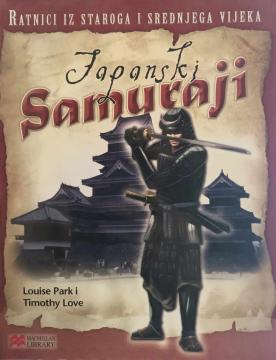
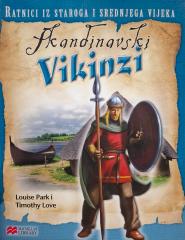
Ratnici iz staroga i srednjega vijeka - Japanski samuraji

Ratnici iz staroga i srednjega vijeka - Japanski samuraji

Louise Park, Timothy Love

Japanese samurai were the elite warriors of feudal Japan, known for their skill in battle and strict honor. The word "samurai" means "one who serves".

They followed a code of conduct known as bushido (the way of the warrior), which emphasized values ​​such as courage, honor, loyalty and self-discipline.

Samurai carried two swords, a katana and a wakizashi, known as a daisho. Their role was to protect the lord, whether he was a nobleman, a feudal lord or an emperor. If their honor was violated, they had to commit ritual suicide known as seppuku.

Their history goes back to the Heian period, when wealthy landowners began to create their own armies for defense. Samurai became instrumental in military conflicts and political turmoil until the end of the 19th century, when the Meiji reforms led to the modernization of Japan and the abolition of the samurai class.

Editor
Julia Carlomagno
Illustrations
Colbi Heppell, Giovanni Caselli, Paul Konye
Graphics design
Cristina Neri,
Dimensions
27.5 x 21.5 cm
Pages
32
Publisher
MacMillan Library, South Yarra, 2009.
 
Latin alphabet. Paperback.
Language: Croatian.
ISBN
978-9-53323-000-9

No copies available

The last copy was sold recently.
 

Are you interested in another book? You can search the offer using our search engine or browse books by category.

You may also be interested in these titles

Tom Sojer

Tom Sojer

Mark Twain, Paula Župan Jazbec

The story is known for its humor, colorful characters and nostalgic portrayal of childhood.

Jugoreklam, 1982.
Croatian. Latin alphabet. Hardcover.
4.26
U potrazi za smijehom

U potrazi za smijehom

Pavao Despot

These are stories for children that are written with a special sense of humor and imagination.

Centar za informacije i publicitet (CIP), 1990.
Croatian. Latin alphabet. Hardcover.
3.68
Pepeljuga, Kuća malena, Pedro

Pepeljuga, Kuća malena, Pedro

Walt Disney

All three stories are gentle, educational, and have a happy ending – ideal for children aged 4–10.

Mladinska knjiga Založba, 1987.
Croatian. Latin alphabet. Hardcover.
9.98
Mala zvijezda

Mala zvijezda

Dubravka Pađen-Farkaš

Spells never end: From the cosmic workshop of the author Little Mermaid, a small star has arrived in the blue depths.

Grafika, 2001.
Croatian. Latin alphabet. Hardcover.
2.44
Dolazak obećanog spasitelja

Dolazak obećanog spasitelja

Bible stories for children

24 sata.
Croatian. Latin alphabet. Paperback.
2.48
Djevojka cara nadmudrila / Dva novca: Srpske narodne pripovijetke

Djevojka cara nadmudrila / Dva novca: Srpske narodne pripovijetke

About the origin of the short story The girl outsmarted the emperor by Vuk St. Karadžić says that it was sent to him by pop Vuk Popović from Risno in Boka Kotorska. About the short story Two Money, he says: "I heard it from a beggar in Novi Sad, but I wro

Naša djeca, 1964.
Croatian. Latin alphabet. Hardcover.
4.62