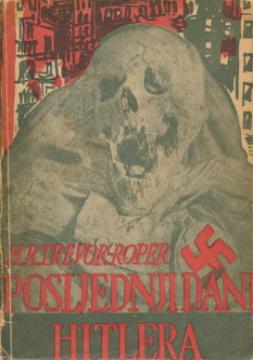
Posljednji dani Hitlera

Posljednji dani Hitlera

Hugh Redwald Trevor-Roper

A study reconstructing the events in Hitler's bunker. The author, a British historian and intelligence officer, was tasked with investigating the circumstances of Hitler's death, debunking the propaganda and rumors that circulated after the fall of the Th

Trevor-Roper describes in detail the atmosphere inside the Führerbunker, where Hitler and his closest associates – Eva Braun, Goebbels, Himmler and others – spent their final days under constant bombardment by the Red Army. The book follows Hitler’s paranoia, loss of touch with reality and his final decision to commit suicide on April 30, 1945. It also covers the fates of other Nazi leaders and the chaotic collapse of the regime after Hitler’s death.

Through analysis of survivor testimonies, documents and his own research, Trevor-Roper provides a thorough insight into the end of Nazi rule, debunking myths and propaganda lies. The book remains one of the key works on Hitler’s final days, providing insight into the psychology of a dictator and the collapse of a totalitarian system.

Original title
The Last Days of Hitler
Translation
Bogdan Krizman
Editor
Ive Mihovilović
Graphics design
Raul Goldoni
Dimensions
20 x 14 cm
Pages
223
Publisher
Zora, Zagreb, 1951.
 
Latin alphabet. Paperback with dust jacket.
Language: Croatian.

Multiple copies are available

Copy number 1

Condition:Used, excellent condition

Copy number 2

Condition:Used, good condition (visible signs of use)
Damages or inconvenience notice:
  • Traces of patina
  • Slight damage to the cover

Copy number 3

Condition:Used, good condition (visible signs of use)
Damages or inconvenience notice:
  • Damaged back
  • Damaged book cover
Discounted price: 7.995.59
30% discount is valid until 3/24/26 11:59 pm
 

Are you interested in another book? You can search the offer using our search engine or browse books by category.

You may also be interested in these titles

Partizanska i komunistička represija i zločini u Hrvatskoj 1944.-1946.: dokumenti. Knjiga 2: Slavonija, Srijem i Baranja

Partizanska i komunistička represija i zločini u Hrvatskoj 1944.-1946.: dokumenti. Knjiga 2: Slavonija, Srijem i Baranja

Vladimir Geiger

The first critical edition of original documents (187 of them) of units and institutions of the NOV and PO of Yugoslavia and Croatia on the actions taken against defeated military and political opponents in the area of ​​Slavonia, Srijem and Baranja befor

Hrvatski institut za povijest, 2006.
Croatian. Latin alphabet. Hardcover.
15.42
Komunizam i čovjek: Odnos vlasti i pojedinca u Hrvatskoj (1958.–1972.)

Komunizam i čovjek: Odnos vlasti i pojedinca u Hrvatskoj (1958.–1972.)

Josip Mihaljević

Josip Mihaljević's book analyzes the relationship between the government and the individual in communist Croatia (1958–1972), through repressive mechanisms, ideological pressures, and restrictions on personal freedom in the socialist system.

Hrvatski institut za povijest, 2016.
Croatian. Latin alphabet. Hardcover.
17.26
Teror narodu: Povijest OZNE, Titove političke policije

Teror narodu: Povijest OZNE, Titove političke policije

William Klinger

In the book, historian William Klinger investigates the origin and operation of OZNA - the brutal repressive apparatus of communist Yugoslavia, which monitored, imprisoned and liquidated political opponents.

Večernji list, 2014.
Croatian. Latin alphabet. Paperback.
7.34
Izabrani radovi

Izabrani radovi

Ljubo Boban

Selected Works of Academician Ljubo Boban (2022) brings together key texts on contemporary Croatian history of the 20th century. The foreword by Damir Agičić highlights Boban's methodological rigor and objectivity in researching sensitive topics.

Srednja Europa, 2022.
Croatian. Latin alphabet. Hardcover.
24.52
Radni logor Valpovo 1945.-1946.: dokumenti

Radni logor Valpovo 1945.-1946.: dokumenti

Vladimir Geiger

The Valpovo labor camp (1945–1946) was the largest camp for Volksdeutschers in Croatia after World War II. About 4,000 Germans and Austrians were interned; at least 1,074 died, mostly from hunger, disease, and exhausting labor.

Njemačka zajednica podunavskih Švaba u Hrvatskoj, 1999.
Croatian. Latin alphabet. Hardcover.
27.34