Matijino stoljeće rata

Matijino stoljeće rata

Ivan Šimić

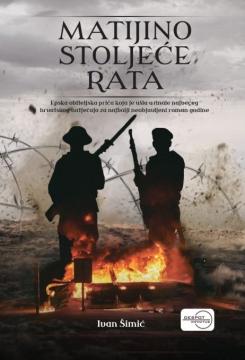
Matija's Century of War is an epic, so Croatian story about the 20th century written in a superior narrative and style, which you will not read, but swallow!

By intertwining fiction and real events, not caring about literary-theoretical laws and rigid genre molds, about which according to his own admission he knows little or nothing anyway, the obviously well-informed author brings testimonies about people and events in a really wide temporal and spatial scope, thus tragic fate convincingly places the titular heroines in the historical context that actually decisively determined that fate. To that extent, this book is simultaneously a Chronique du xxe siècle, as the subtitle suggests, but also a moving story about a woman who survived as many as three wars, losing in each of them one of her closest relatives.

The first chapter - via Imotski, Split and Trieste - takes us on an exciting journey from Herzegovina to New York, where we follow the failed attempt of Matija's father Mata to move to America (this failure is a kind of capstone of a series of later family misfortunes), the second tells about Matina tragic fate in the First World War, from fighting and capture in Galicia to imprisonment in deep Russia, and the third and fourth about the fate of his descendants through two new cataclysms, from Herzegovina in the Second World War to Sarajevo in the last war in the nineties.

Our Matija, the main character of the novel, was born in 1912. That woman's father was killed in the first of her three wars, her husband was killed in the second, and her son and grandson in the third. Matija died in 1995, after all these tragedies through four generations.

Editor
Danijel Tatić
Graphics design
Dražen Štebih
Dimensions
20 x 14 cm
Pages
326
Publisher
Despot Infinitus d.o.o., Zagreb, 2024.
 
Latin alphabet. Paperback.
Language: Croatian.
ISBN
978-9-53366-149-0

One copy is available

Condition:Unused
 

Are you interested in another book? You can search the offer using our search engine or browse books by category.

You may also be interested in these titles

Pokošeno polje

Pokošeno polje

Branimir Ćosić

Mown Fields (1933) represents the culmination and swan song of a life that ended too soon – the author finished the novel just five months before his death from tuberculosis, at the age of thirty-one.

Svjetlost, 1961.
Serbian. Latin alphabet. Hardcover.
The book consists of two volumes
5.34
Djevojka s Leicom

Djevojka s Leicom

Helena Janeczek

The novel is a kaleidoscopic, polyphonic account of the life of Gerda Taro (née Gerda Pohorylle, 1910–1937), the first female war photographer to die on the battlefield. A must-read for fans of historical fiction about strong women and anti-fascism.

Naklada Ljevak, 2020.
Croatian. Latin alphabet. Hardcover with dust jacket.
13.72
Đavo govori španjolski

Đavo govori španjolski

Zdeněk Němeček

The novel tells a moving story about the Spanish Civil War. Through the fates of journalists, intellectuals and ordinary people, it depicts the brutality, ideological conflicts and demonic side of a war in which "the devil speaks Spanish".

Savremena biblioteka, 1940.
Croatian. Latin alphabet. Hardcover with dust jacket.
11.36
Vrijeme nasilja

Vrijeme nasilja

Jean-Pierre Simon

A Time of Violence (1966) is an anti-war and activist novel by French writer Jean-Pierre Simon, a lesser-known author from the mid-20th century, whose work bears traces of leftist literature of the 1930s and 1940s.

Svjetlost, 1965.
Croatian. Latin alphabet. Paperback.
2.46
Trijumfalna kapija

Trijumfalna kapija

Erich Maria Remarque

Paris 1939. German refugee doctor Ravic lives without documents and a homeland. In the midst of the coming war, he finds passionate love, but also an opportunity for revenge. A classic about exile and humanity.

Narodna knjiga, 1960.
Serbian. Cyrillic alphabet. Hardcover.
4.76
Iskra života

Iskra života

Erich Maria Remarque

Spark of Life follows a group of inmates in a Nazi concentration camp who, despite the constant terror, retain their moral strength and humanity. The novel depicts the struggle of the spirit against systematic destruction and the need for hope.

Džepna knjiga, 1955.
Serbian. Latin alphabet. Paperback.
3.00 - 3.24