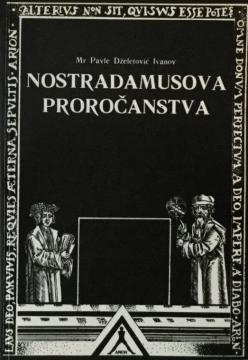
Nostradamusova proročanstva

Nostradamusova proročanstva

Pavle Dželatović-Ivanov

The prophecies of Nostradamus, the famous French astrologer and physician from the 16th century, were recorded in his work Les Prophéties, published in 1555.

The work consists of 942 prophecies written in the form of quatrains (quatrains), divided into groups of 100 quatrains each, known as centuries. Nostradamus wrote his prophecies in a poetic and enigmatic style, often using symbolism, allusions and anagrams to obscure their meaning.

Nostradamus claimed to have predicted a series of significant events in world history using astrology and introspective visions. His quatrains are not written in clear and direct language, but are full of metaphors and symbols, which makes their interpretation difficult. Quatrains are often interpreted retrospectively, crediting Nostradamus with predicting events such as the French Revolution, the rise of Napoleon and Hitler, as well as world wars and modern catastrophes.

Nostradamus' verses are often considered by critics to be too general, which allows them to be applied to almost any event. His prophecies are usually interpreted only after a certain historical event has occurred. The meaning of the verses often varies depending on the translation, which makes accurate interpretation even more difficult.

Despite criticism, Nostradamus' prophecies continue to fascinate and intrigue people around the world, serving as inspiration for numerous books, films and conspiracy theories.

Editor
Dragan Simović
Illustrations
Milena Balabanić
Dimensions
20 x 14 cm
Pages
158
Publisher
Arion, Zemun, 1988.
 
Distribution: 3,000 copies
 
Latin alphabet. Paperback.
Language: Serbian.
ISBN
8-67-371030-8

No copies available

The last copy was sold recently.

 

Are you interested in another book? You can search the offer using our search engine or browse books by category.

You may also be interested in these titles

Kraj vremena: Revizija proročanstva Maya

Kraj vremena: Revizija proročanstva Maya

Adrian Gilbert

British author Adrian Gilbert (co-author of The Mayan Prophecies from 1995) in The End of Time offers the most thorough and sober modern interpretation of the Mayan calendar and the so-called "2012 prophecy", completely rejecting New Age hysteria.

Stari grad, 2009.
Croatian. Latin alphabet. Hardcover.
18.2212.75 - 18.2412.77
Prije nego odemo predaleko: Roman iz višedimenzionalne stvarnosti

Prije nego odemo predaleko: Roman iz višedimenzionalne stvarnosti

Adrian Predrag Kezele

The novel "Before we go too far" by Adrian P. Kezele is set in the year 2047. Four people from one future move into a parallel world after the worlds split, discovering the consequences of our present-day decisions.

Dvostruka duga, 2012.
Croatian. Latin alphabet. Paperback.
14.26
Kremansko proročanstvo: Šta je bilo, šta nas čeka?

Kremansko proročanstvo: Šta je bilo, šta nas čeka?

Dragoljub Golubović, Dejan Milenković

The Kreman Prophecy is a non-fiction book that investigates the origins, interpretations and credibility of the Kreman Prophecy and examines its alleged predictions of past and future events.

BIGZ, 1988.
Serbian. Latin alphabet. Paperback.
14.32
Prije faraona: Tajanstvena pretpovijest Egipta

Prije faraona: Tajanstvena pretpovijest Egipta

Edward F. Malkowski

American researcher Edward Malkowski claims in his book Before the Pharaohs that Egyptian civilization is the successor to a much older, more technologically advanced culture that existed at least 10–12 thousand years before the dynastic period.

Stari grad, 2006.
Croatian. Latin alphabet. Hardcover.
16.2812.21 - 16.3212.24
Zabranjena religija: zatajene hereze Zapada

Zabranjena religija: zatajene hereze Zapada

J. Douglas Kenyon, Richard Russell Cassaro, David Lewis, Cyntia Logan, Peter Novak, Mark Amaru Pi...

Forbidden Religion is a collection of 40 essays by renowned alternative history and spirituality authors, compiled by J. Douglas Kenyon. Extremely readable, richly illustrated, it remains one of the best introductions to the "forbidden" spiritual history

Stari grad, 2008.
Croatian. Latin alphabet. Hardcover.
18.2412.77 - 18.3413.76
Jesu li bogovi bili astronauti?

Jesu li bogovi bili astronauti?

Ernst von Khuon

According to Daeniken, humanity owes the rise of its culture to astronauts from other stars. In this book, numerous top experts discuss Erich von Daeniken's theses.

Stvarnost, 1972.
Croatian. Latin alphabet. Paperback.
4.98