Velikani hrvatske prošlosti

Velikani hrvatske prošlosti

Hrvoje Kekez

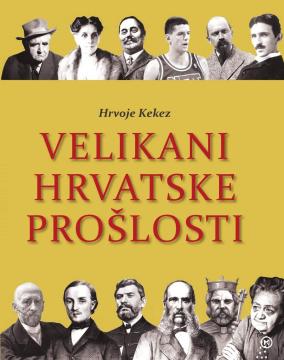
The book presents 150 great men of the Croatian past. In one place you will find biographies of the greatest Croatian writers, politicians, composers, sculptors, military leaders, athletes, church dignitaries, painters...

We are talking about persons who have made a debt to the Croatian people, but also to the whole of Europe, acting in different fields of social life. Among them are Croatian princes and kings from the early Middle Ages, but also numerous politicians and military leaders, scientists and inventors, writers and artists, scholars and church dignitaries, athletes and researchers. The book includes many famous people from the time of Prince Ljudevit from the beginning of the 9th century, all the way to the basketball Mozart, Dražen Petrović.

The author of 40 illustrations (portraits of great men) is Dino Idrizbegović. The photographs in the book were collected from various institutions (Croatian State Archives, National and University Library, Modern Gallery, Tošo Dabac Archive, HAZU, HNK in Zagreb). The author of a smaller number of photos is Ivica Jandrijević.

Every country proudly highlights its identity. Some of them are widely known for their cultural and historical monuments and natural phenomena. But many of them were inhabited and created by people who changed the world in some way. Croats can also be proud of the richness of their cultural, political and social history.

Editor
Vid Jakša Opačić
Illustrations
Dino Idrizbegović, Ivica Jandrijević
Graphics design
Marko Jovanovac
Dimensions
31 x 24 cm
Pages
320
Publisher
Mozaik knjiga, Zagreb, 2013.
 
Latin alphabet. Hardcover.
Language: Croatian.
ISBN
978-9-53141-454-8

No copies available

The last copy was sold recently.
 

Are you interested in another book? You can search the offer using our search engine or browse books by category.

You may also be interested in these titles

Najveći hrvatski znanstvenici

Najveći hrvatski znanstvenici

Hrvoje Kekez

This book presents forty of the most distinguished Croatian scientists from the late Middle Ages to the present day, i.e. from Benedikt Kotruljević to Ivan Supek.

Mozaik knjiga, 2011.
Croatian. Latin alphabet. Paperback.
6.32
Glavaš – kronika jedne destrukcije

Glavaš – kronika jedne destrukcije

Drago Hedl

In Glavaš – Chronicle of a Destruction, Drago Hedl reveals the rise and fall of Branimir Glavaš, through a story of power, crime, and moral decline in post-war Slavonia. The documentary research turns into a poignant chronicle of our society.

Novi Liber, 2010.
Croatian. Latin alphabet. Paperback.
22.46
Tragom prošlosti Broda

Tragom prošlosti Broda

Vladimir Rem

A local feuilleton chronicle of Slavonski Brod from Roman times (Marsunija), through Turkish rule, the Military Border and the fortress to the 19th/20th century. A warm, nostalgic account of the history, customs and sights of the town.

Vlastita naklada, 1965.
Croatian. Latin alphabet. Paperback.
6.72
Na vratima Požeške doline

Na vratima Požeške doline

Dragutin Pavličević

A classic of local historiography, it depicts the history, geography and culture of the Požega Valley from prehistoric times to the modern era. The work describes the region's strategic position, the influences of the Romans, Ottomans and Habsburgs, with

Matica hrvatska, 1961.
Croatian. Latin alphabet. Paperback.
12.36
Komunizam i čovjek: Odnos vlasti i pojedinca u Hrvatskoj (1958.–1972.)

Komunizam i čovjek: Odnos vlasti i pojedinca u Hrvatskoj (1958.–1972.)

Josip Mihaljević

Josip Mihaljević's book analyzes the relationship between the government and the individual in communist Croatia (1958–1972), through repressive mechanisms, ideological pressures, and restrictions on personal freedom in the socialist system.

Hrvatski institut za povijest, 2016.
Croatian. Latin alphabet. Hardcover.
17.26
Radni logor Valpovo 1945.-1946.: dokumenti

Radni logor Valpovo 1945.-1946.: dokumenti

Vladimir Geiger

The Valpovo labor camp (1945–1946) was the largest camp for Volksdeutschers in Croatia after World War II. About 4,000 Germans and Austrians were interned; at least 1,074 died, mostly from hunger, disease, and exhausting labor.

Njemačka zajednica podunavskih Švaba u Hrvatskoj, 1999.
Croatian. Latin alphabet. Hardcover.
27.34