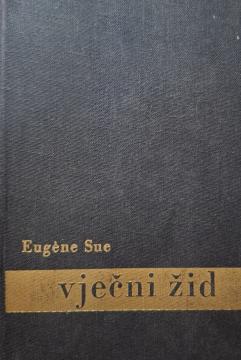
Vječni žid

Vječni žid

Eugene Sue

"The Wandering Jew" (French: "Le Juif errant") is a novel by Eugène Sue, first published in 1844.

Set in Europe, the story follows the fate of Israel, an indelible figure who symbolizes the suffering and persecution of Jews throughout history. The main character, Mattathias, bears the burden of eternal condemnation and exile, traveling through different countries and eras, facing prejudice and abuse.

Throughout his journey, the novel explores themes of identity, religion, and social justice, highlighting the hardships faced by Jews, as well as their resilience and ability to survive. Sue uses this character to criticize social injustices and highlight universal human values, calling for tolerance and understanding among peoples. Through rich descriptions and emotional narration, "The Eternal Jew" leaves a strong impression of the importance of coexistence and human rights.

Original title
Le Juif errant
Translation
Ivo Klarić
Dimensions
20 x 13 cm
Pages
385
Publisher
Matica hrvatska, Zagreb, 1969.
 
Latin alphabet. Hardcover.
Language: Croatian.

One copy is available

Condition:Used, excellent condition
 

Are you interested in another book? You can search the offer using our search engine or browse books by category.

You may also be interested in these titles

Antologija hrvatske drame Sv. 2: Od ilirizma do moderne

Antologija hrvatske drame Sv. 2: Od ilirizma do moderne

Branko Hećimović

The anthology of Croatian drama by B. Hećimović is the second (after Marijan Matković's) anthology edition that represents the development of the entire national drama, with the fact that Hećimović's selection is much wider.

Znanje, 1988.
Croatian. Latin alphabet. Paperback.
6.74
Grešnik Lenart

Grešnik Lenart

Ivan Cankar

"Sinner Lenart" is a novella by Slovenian writer Ivan Cankar that deals with themes of redemption, moral dilemmas, and the inner struggle of the individual.

Spektar, 1974.
Croatian. Latin alphabet. Hardcover.
2.86 - 3.26
Figarova ženidba ili Ludi dan: Komedija u pet ćinova

Figarova ženidba ili Ludi dan: Komedija u pet ćinova

Pierre-Augustin Caron de Beaumarchais

The comedy "The Marriage of Figaro, or The Mad Day" (1784) is a sequel to The Barber of Seville. The Marriage of Figaro criticizes social injustices through love affairs and intrigue, celebrating Figaro and Susanna's ingenuity in the fight against aristoc

Srpska književna zadruga (SKZ), 1925.
Serbian. Cyrillic alphabet. Hardcover.
7.58
Djela #15: Pripovetke / Drame

Djela #15: Pripovetke / Drame

Maksim Gorki

The book contains the following stories and plays: Three Days, Theft, Criminals, Thefts, Fake Money and The Old Man.

Kultura, 1949.
Serbian. Latin alphabet. Hardcover.
4.56
Sluškinja Ančka

Sluškinja Ančka

Fran Saleški-Finžgar

"The Maid Ančka" is a novel by Slovenian author Fran Saleški Finžgar that takes place in a rural setting.

Spektar, 1974.
Croatian. Latin alphabet. Hardcover.
2.26 - 3.46
Grof Ivan: Igrokaz u pet čina

Grof Ivan: Igrokaz u pet čina

Vladimir Mažuranić

Vladimir Mažuranić's drama Count Ivan is a historical play in five acts that deals with political and social conflicts in Croatia during the 17th century. The work was awarded the Dušan Kotur Foundation Literary Award.

Matica hrvatska, 1883.
Croatian. Latin alphabet. Paperback.
12.48