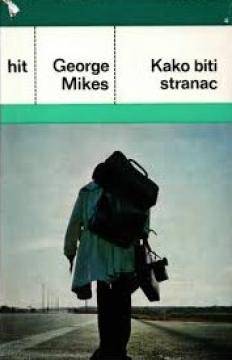
Kako biti stranac

Kako biti stranac

George Mikes

How to Be a Foreigner by George Mikes is a humorous book in which the author, as an immigrant from Hungary, humorously describes British customs, mentality, and everyday life from the perspective of a foreigner.

How to Be a Foreigner is the most famous work of the Hungarian-British writer and journalist George Mikes. The book was based on the author's experiences after moving from Hungary to England and presents a humorous account of British society seen through the eyes of a foreigner. Although it was published immediately after World War II, it remained popular due to its universal humor and insightful observations about national characters.

The work is not a novel with a classic plot, but a collection of interconnected humorous essays and short chapters. In them, Mikes describes his attempts to understand English customs, language and ways of thinking. He pays special attention to everyday situations such as conversations about the weather, rules of conduct, attitudes towards privacy, sports, food and social differences.

The author, with much irony, depicts the English as a people who value restraint, politeness and tradition, but at the same time often hide their feelings behind formal behavior. Many episodes are based on misunderstandings that arise due to cultural differences between a continental European and the British way of life. It is from these situations that most of the humor comes.

Mikes does not mock the English maliciously, but with warmth and sympathy. At the same time, he often jokes at his own expense, showing how a foreigner tries to adapt to a society whose rules are not always clear. His observations about identity, belonging, and cultural differences remain relevant today.

Original title
How to be an alien
Translation
Nikola Kršić
Editor
Nikola Kršić
Dimensions
19 x 12 cm
Pages
226
Publisher
Znanje, Zagreb, 1980.
 
Latin alphabet. Hardcover with dust jacket.
Language: Croatian.

One copy is available

Condition:Used, excellent condition
 

Are you interested in another book? You can search the offer using our search engine or browse books by category.

You may also be interested in these titles

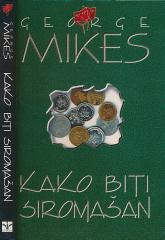
Kako biti siromašan

Kako biti siromašan

George Mikes

Humorist Georges Mikes, of Hungarian origin, spent part of his life in London. In this book, he selflessly teaches us how to stay poor.

Izvori, 1996.
Croatian. Latin alphabet. Hardcover.
6.98
Život Betovenov

Život Betovenov

Romain Rolland

The translation of this book was originally published in 1923 by the Belgrade bookseller S. B. Cvijanović, but the entire edition was confiscated and destroyed by the Germans during the Second World War.

Matica srpska, 1947.
Croatian. Latin alphabet. Paperback.
5.24
Dunav: P.S. 1991. vukovarske razglednice

Dunav: P.S. 1991. vukovarske razglednice

Pavao Pavličić

A moving and poignant chronicle of the siege and destruction of Vukovar in 1991 through 57 short "postcard" chapters. Pavličić does not write from the perspective of an "ordinary" Zagreb resident who spent the summer of 1991 in Vukovar, and then followed

Hena Com, 1999.
Croatian. Latin alphabet. Hardcover.
11.26
Pismo nerođenom djetetu

Pismo nerođenom djetetu

Oriana Fallaci

One of the most moving and courageous works of world literature of the 20th century. Written as a long monologue by a pregnant woman (Fallaci herself), the book is at once an intimate confession, a feminist manifesto, and a philosophical confrontation wit

Znanje, 2009.
Croatian. Latin alphabet. Paperback.
4.56
Primicanje katastrofa: Propasti koje prijete našem svijetu

Primicanje katastrofa: Propasti koje prijete našem svijetu

Isaac Asimov

A popular science work in which Asimov, combining scientific rigor with a lucid style, explores possible threats to the survival of humanity, systematizing disasters according to their nature and probability.

August Cesarec, 1981.
Croatian. Latin alphabet. Hardcover with dust jacket.
7.46
Sjećanja

Sjećanja

Ivan Maček-Matija

The book provides an insight into the political and social changes of that time, as well as the author's personal reflections on the events and people who shaped his life.

Globus, 1983.
Croatian. Latin alphabet. Hardcover with dust jacket.
10.98